A Buyer’s First Clue Is Often a Fabric Sample
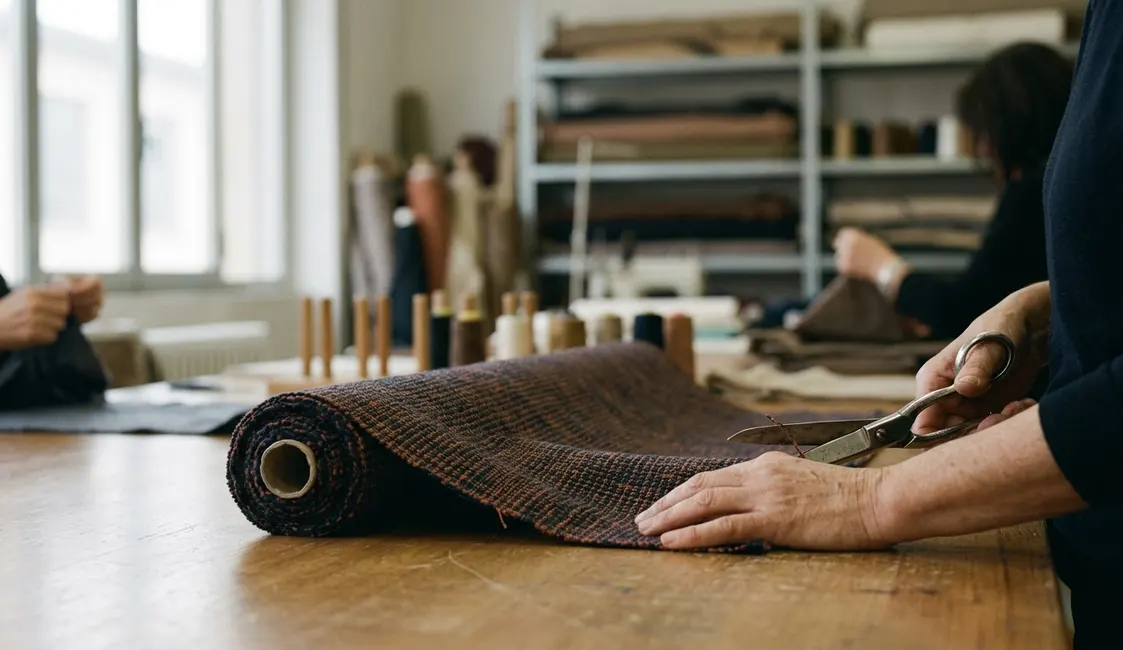
In a Carpi workshop, the first conversation rarely starts with a spreadsheet. It starts with a hand on fabric.
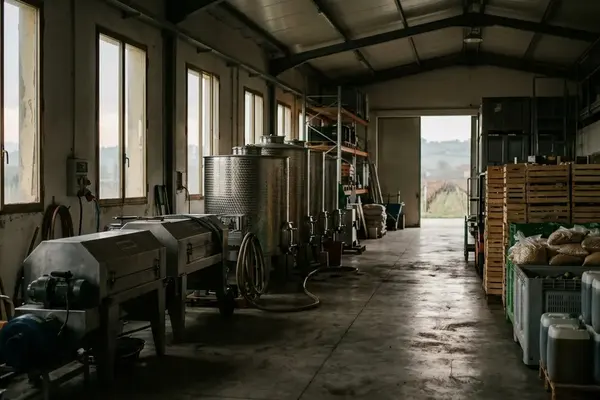
A buyer lifts an interlock sample, folds it once, then compares it with a doubleface knit laid beside it. Nearby, circular machines keep moving through fleece and other knit structures. The sound matters. It tells the buyer that Modena’s fashion export market is not only a showroom economy; it is also a production system.
That is the case-study lens I use here. Modena fashion and textile exports should be read as a layered district connecting design, knitwear, labels, embroidery, accessories, leather goods, footwear, eyewear, machinery, and technical materials. If you only look for finished fashion brands, you miss the suppliers that make a collection workable.
This guide follows a simple sourcing sequence for international buyers, Modena exporters, associations, and institutional stakeholders. The goal is practical: understand what the district can do, where each company sits in the value chain, and which questions to ask before sourcing.
The Challenge: A District That Looks Fragmented from the Outside
Why the first search can mislead
A generic search for Italian textile companies can miss Modena suppliers whose export value sits in labels, anti-counterfeiting systems, embroidery machinery, samples, or technical material processing rather than finished garments.
From the buyer side, the district can look scattered. One search result points to haute couture prêt-à-porter. Another points to intimate apparel. A third leads to embroidery, eyewear, men’s loafers, leather goods, or machinery. If the buyer uses a single category such as “Made in Italy fashion,” the map becomes too flat.
The systemic challenge is classification. Many firms do not present themselves as broad apparel vendors because their role is narrower and often more valuable: specialist supplier, private-label producer, component maker, process partner, or finishing expert.
Buyer point: The district makes more sense when you classify companies by function before you classify them by product category.
A brand-led doorway into the district
Anna Marchetti S.R.L. gives buyers an early reference point. The company was founded in 1966, held its first fashion show in Modena, and from 1979 anchored itself at Via Salgari 40. Its identity developed around Anna Marchetti’s Total Look philosophy, with Jessica involved in public relations and creations.
I treat that history as an identity signal, not as a shortcut to a purchase decision. A brand story helps the buyer understand positioning. It does not replace capacity checks, delivery terms, references, or product testing.
Brand-Led Segments: From Total Look to Intimate Apparel and Knitwear
The visible layer of the district is useful because it shows how Modena companies define market use cases. Anna Marchetti works through haute couture prêt-à-porter and the Villa Freto line for the Mediterranean woman. Collezioni Srl and Cosabella sit in intimate apparel. Baroni S.P.A. presents Baroni Woman and Baroni Man. Pretty Mode brings PaolaJoy and JoyLab. Other visible names include Ann Max Export, BB Fabio, and Batte il Cuore.
That variety is not random. It reflects a segmentation habit I often see in stronger districts: companies choose a precise buyer problem and shape the product around it.
- Elegant womenswear for boutiques and occasion-led retail.
- Sportive menswear with clear wardrobe positioning.
- Size-inclusive fashion and easywear for repeat purchasing.
- Loungewear and intimate apparel where comfort, fit, and fabric memory matter.
- Fully-fashioned knitwear and technical sportswear where construction carries the sale.
Cosabella and product memory
Cosabella is a useful case because the brand memory is tied to a product focus. Ugo Campello co-founded the brand in 1983. Early recognition came in the mid-1980s through bodysuit designs and the best-selling Soiré line.
For an international buyer, that is the lesson: a brand does not need to explain everything. It needs one strong product association that buyers, merchandisers, and repeat customers can remember.
The Production Backbone: Knitting, Embroidery, Machinery, and Samples
Before the collection exists
Before a buyer places a larger order, someone has to solve fabric behavior, fit, sampling, and repeatability. This is where the Carpi (MO) backbone matters.
Centertex S.r.l., founded in 1978 in Carpi, operates circular machines and produces structures such as interlock, doubleface, ribs, and plush. Its material combinations include acrylic-cotton, cotton-acrylic, wool-viscose, and viscose-fibre blends across different lines.
That matters because knitwear sourcing is not the same as buying a finished style from a catalogue. The buyer has to ask how the fabric behaves after development, how the sample translates into production, and whether the supplier can repeat the same hand-feel across orders.
During development
Alexander S.r.l., established in 1980, sits closer to the development problem. Its internal styling, prototyping, and sample production can help buyers who arrive with an idea but not yet with a complete technical package.
This is often the stage where sourcing either becomes precise or becomes expensive. A good sample room saves time because it reveals the trade-offs early: stitch density, weight, drape, finishing, and size grading.
Machinery as district knowledge
Comac Sas adds another layer. Founded in 1969 under Kelm Siegfried, the company is linked to cotton looms, electronic rectilinear machines, Scheller loom servicing, and specialized Finura transformations.
Machinery suppliers and service specialists rarely appear in the first buyer presentation. Still, they shape what the district can do at scale. When production needs shift, machinery knowledge becomes part of the export offer.
Why Labels, Embellishment, and Accessories Matter to Export Buyers
Export readiness often gets decided after the main garment design. The label, badge, security tag, emblem, woven element, printed package, crystal, stud, or embroidery detail can determine whether a collection feels complete in a foreign market.
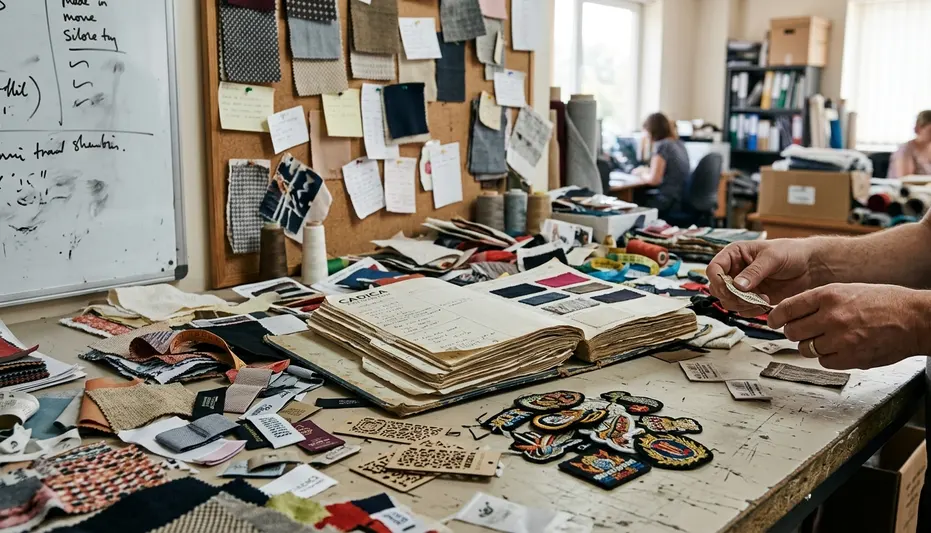
Cadica Group S.p.A. is the core example. Founded in Carpi in 1973, the company moved in the early 1980s toward global service and design consultancy. Its CADICA TRENDBOOK works as a seasonal technical-design resource, while its capabilities include laser-cut or laser die-cut badges, woven and printed labels, and anti-counterfeiting or forgery-proof labeling programs.
For buyers, this is not decoration. It is identity, compliance support, and product protection bundled into the finishing system.
Cattini & Figli S.r.l. shows the same logic from another angle. Its work spans woven labels, self-adhesive labels, PVC labels, polypropylene film, taffetas, satin, and hot heat-engraved techniques. That mix gives a buyer more control over material feel and packaging language.
Procurement point: Treat label sourcing as its own procurement task. It concerns identity, compliance, and product protection, while knitwear sourcing concerns material, fit, sample development, and production repeatability.
Adjacent Specialists Expand the District Beyond Apparel
Leather, PVC, and accessory materials
The district becomes clearer when we follow materials beyond apparel. Pelletteria Italiana U.B. Land Italia and Bevini Modena connect the map to leather types such as Dollaro, Zeus, and Matisse. Nerocipria by Martini Morena works with quilted PVC, PVC tarpaulin, wool pairings, and vertically managed styling-to-packaging processes.
This gives the buyer a wider set of collection tools. A knitwear capsule can sit beside a coordinated clutch. A sportswear concept can use accessory materials that carry the same color and texture story.
Footwear and eyewear
Calzaturificio Loncar Due S.r.l. began as an artisan shoemaker in the early 1950s and shifted toward men’s loafers in the 1960s. Occhialeria Solgir, founded in 1973, uses Monel metal, nickel-silver, acetate sheet, and pantograph working; it launched the Texsò line in 1990.
Those facts matter because they move the district from a garment-only view to a wardrobe view. Apparel, eyewear, footwear, and leather accessories can reinforce the same market position when buyers plan them together.
Technical materials at the edge
GM Lavorazioni Pellame by Gianferrari Katia shows the unusual edge of the system. The company works with bellows for ceramic molds, aramid, SFS, PVC/polyester, heat-sealing, and waterjet cutting.
A fashion buyer may not need ceramic mold bellows. But the capability tells us something important: textile and material skills in Modena can cross into protection, performance, and industrial applications. That is the same territorial logic one sees when comparing material know-how from Carpi to industrial districts around Fiorano Modenese (MO).
The Solution: Read Modena as a Value-Chain Map, Not a Single Category
Here is the practical method I use with buyers: start from the commercial problem, then assign supplier roles.
- Brand owner: useful for market testing through finished collections.
- Knitwear producer: useful when fabric, fit, and repeat production matter.
- Private-label partner: useful when the buyer owns the concept but needs development and production support.
- Machinery supplier: useful when technical production must scale or change.
- Embellishment specialist: useful for embroidery, badges, studs, crystals, and surface identity.
- Label and packaging provider: useful for compliance, anti-counterfeiting, and brand presentation.
- Accessory maker: useful for leather goods, bags, eyewear, footwear, and coordinated capsule pieces.
- Technical material processor: useful when fabric skills cross into protective or industrial products.
The pathway then becomes more concrete. Start with finished-brand suppliers for market testing. Add knitwear and sample-production partners for private-label development. Use label, badge, and embroidery suppliers to localize product identity. Involve machinery or process specialists when technical production needs to scale.
C.S.C. Società Cooperativa and Marisa also belong in this functional view when buyers look at private-label copacking and recycled-material REMAKE products. The label on the door matters less than the role the supplier can play in the buyer’s workflow.
For non-EU buyers, I would also check product rules early through the EU Access2Markets import requirements database. Ask suppliers which documentation, labeling rules, and quality systems such as ISO 9001 or ISO 9002 are relevant to the specific product, rather than assuming one certificate covers every case.
Results: What This District Can Demonstrate Without Overclaiming
The results in this case study are best read as market-readiness signals, not as unsupported export totals. We can observe continuity, documented founding years, product specialization, machinery depth, brand segmentation, material diversity, and named product histories.
Selected Modena fashion and textile export signals| Company or brand | Segment | Distinguishing product or material | Buyer relevance |
|---|---|---|---|
| Anna Marchetti | Haute couture prêt-à-porter and Total Look womenswear | Villa Freto line for the Mediterranean woman | Clear brand positioning for finished-fashion evaluation |
| Centertex S.r.l. | Knitted fabrics | Interlock, doubleface, ribs, plush, and blended yarn structures | Fabric development and production repeatability |
| Cadica Group S.p.A. | Labels, badges, and brand identity systems | CADICA TRENDBOOK, laser-cut badges, woven and printed labels | Collection finishing, localization, and anti-counterfeiting |
| Occhialeria Solgir | Eyewear | Monel metal, nickel-silver, acetate sheet, pantograph working | Accessory expansion beyond apparel |
| GM Lavorazioni Pellame | Technical material processing | Aramid, PVC/polyester, heat-sealing, waterjet cutting | Industrial and protective material applications |
Several continuity markers, as service providers report, support that reading. Anna Marchetti was founded in 1966. Cadica was founded in Carpi in 1973. Centertex dates to 1978. Enne Elle was founded in 1980. Gi& di was established in 1984 and acquired Volley in Italy in 1998. BB Fabio received the 1980 TARGA EXPORT award from the Chamber of Commerce. Baroni has more than 30 years of activity.
Warning: A brand with a long company history is not automatically export-ready for a current buyer; capacity, certifications, delivery terms, product testing, and references still need to be checked.

Once that qualifier is in place, the signal is still useful. A district with both consumer-facing brands and upstream specialists can support prototype-to-production workflows, collection differentiation, accessory matching, and brand protection.
Buyer Use Cases and the Collection-Plan Decision
Four practical routes
If you are sourcing a Made in Italy capsule collection, begin with finished-brand suppliers. You need style coherence, delivery discipline, and a retail story that travels.
If you are developing private-label knitwear, move earlier in the chain. Talk to knitwear producers and sample rooms before you finalize the range. The fabric decision will shape fit, margin, and repeat orders.
If you are upgrading labels and anti-counterfeiting systems, bring in label, badge, packaging, and embroidery suppliers before the collection is locked. Late finishing decisions usually cost more and give fewer options.
If you need accessory or technical-material specialists, widen the search beyond apparel. Leather, PVC, eyewear, footwear, and protective material processors may solve problems that a garment-only supplier cannot touch.
The scene I keep returning to is small. A buyer stands at a worktable in Carpi with a Baroni knitwear sample on the left, a Cadica label option above it, a Nerocipria clutch material swatch to the right, and a Centro Ricamo embroidery sample near the notebook. No purchase order yet. Just coordinated samples, enough to turn a scattered district into a collection plan.