Which China Opportunity Is Realistic for a Modena Exporter?
Which part of the Chinese market can a Modena company credibly serve, with its existing product quality, documentation capacity, and internationalization support?
That question is more useful than asking whether China is large enough to justify attention. It is. Size does not qualify the opportunity. A realistic China plan starts with the exporter’s proof base: product specialization, documentation capacity, and post-sale service model.
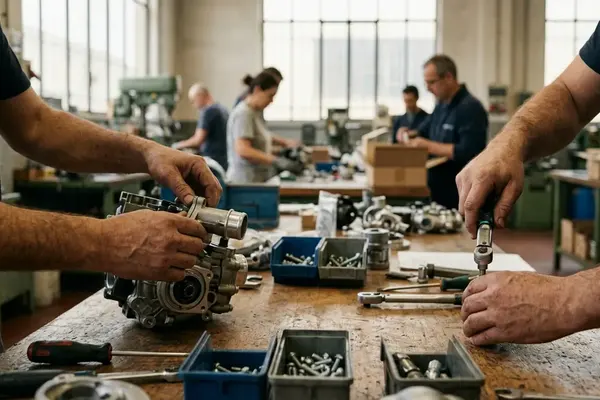
For Modena firms, relevance often comes from industrial-district capability rather than broad export claims. Mechanical production, manufacturing services, ceramics-adjacent machinery, packaging-related equipment, and automotive-related components all create possible openings. The point is not to present the province as a universal supplier. The point is to identify where a buyer can see a clear technical fit.
The first qualification screen
Product specialization: what technical problem does the product or service solve, and for which buyer category?
Documentation capacity: can the company produce consistent product sheets, certification records, customs information, and technical manuals?
Service model: who handles installation, spare parts, maintenance questions, warranty terms, and response times after shipment?
This screen keeps ambition tied to operating capacity. It also prevents a common mistake: treating China as one market instead of a set of sector-specific channels with different proof requirements.
Start With Market Fit, Not Market Entry
Market entry is a late-stage phrase. Market fit comes first.
A China-facing strategy should begin with the offer itself: finished product, component, machinery, technical service, or supplier capability. Each category creates a different burden of proof. A finished product needs buyer-facing specifications and warranty language. A component needs tolerances, repeatability, material information, and integration evidence. Machinery requires installation assumptions, spare-parts logic, maintenance responsibility, and conformity materials.
Separate the offer before selecting the channel
Finished products: prepare product sheets, use cases, warranty terms, and packaging or labeling requirements.
Components: prepare tolerance data, drawings where appropriate, conformity references, and production repeatability evidence.
Technical services: prepare project references, engineering workflow, deliverable boundaries, and communication procedures.
Supplier capabilities: prepare capacity descriptions, quality-system references such as ISO 9001 or ISO 9002 where applicable, and customization limits.
The pre-contact file should include a China-facing company profile, product sheets, certification list, service terms, and an export documentation checklist. This is not paperwork for its own sake. It gives a buyer a reason to continue the technical conversation.
For industrial-use cases, Modena firms should prepare evidence around tolerances, customization boundaries, production repeatability, after-sales responsibility, and technical manuals before approaching buyers. This applies whether the company sits in Fiorano Modenese (MO), Carpi (MO), or another district with supplier depth and export interest.
Where Export Signals Can Be Read Before a Sales Trip
The cheapest China trip is the one postponed until the signals justify it. Desk validation should come before travel spending.
Public and institutional sources can reveal vocabulary, procurement categories, documentation expectations, and sector momentum. The TED European public procurement database is not a China-only sales database, but it helps firms study tender terminology, technical requirement phrasing, and documentation patterns in European public procurement contexts. That language often clarifies how complex buyers describe needs, even when the eventual target market sits outside Europe.
Four buckets for signal scanning
Demand language: how buyers describe the technical need, not how suppliers describe themselves.
Buyer category: distributor, end user, public purchaser, OEM, system integrator, or manufacturing partner.
Standards and conformity references: recurring certification, testing, documentation, or quality-system language.
Evidence needed before travel: product sheets, translated materials, technical manuals, certificates, or service terms.
Fair calendars, buyer delegations, chamber notices, agency newsletters, and sector bulletins perform a different function. They show when a topic has institutional attention. The 2004 Shanghai Service Center newsletters provide a time-specific example of China-related business information circulating through institutional channels, before a company commits to individual outreach.
Procurement databases and institutional newsletters reveal signals and vocabulary; they do not confirm demand from a specific Chinese buyer without direct validation.
How Local Institutions Reduce the Cost of Learning
A field coordinator usually hears the same first concern from smaller exporters: they do not know whether the first contact is serious, representative, or commercially safe.
That is where local institutions reduce the cost of learning. Promec can be framed as an internationalization agency for Modena, with practical support around market orientation, business contacts, missions, and export-readiness activities where applicable. Camera di Commercio di Modena provides the chamber context. Trade associations add sector proximity, especially when the question concerns mechanics, packaging, ceramics-adjacent machinery, or automotive-related supply chains.
What institutional support can and cannot do
Local support can help a firm test target geography, distributor type, procurement route, and fair relevance before committing to buyer visits. It can also improve preparation by checking whether the company has enough material to start a serious conversation.
It does not replace buyer due diligence, legal review, exclusivity negotiation, payment-risk assessment, or price negotiation. Those steps remain commercial responsibilities.
Use institutional orientation before outreach, then separate it from commercial execution. The first stage reduces uncertainty; the second stage assigns risk.
Documentation Is a Commercial Asset, Not an Administrative Detail
Industrial buyers often evaluate the supplier before they evaluate the shipment. Documentation quality shapes that judgment.
A core export dossier should include certificates of origin, product specifications, customs documents, conformity materials, warranty terms, technical manuals, and translated materials when required. UNIONCAMERE can be referenced for export documentation guidance, limited to documentation support rather than market validation.
The dossier that keeps the conversation moving
Certificates of origin and customs documents aligned with the shipment profile.
Product specifications using consistent product codes and technical descriptions.
Conformity materials, certification records, and test evidence where applicable.
Warranty terms and after-sales responsibility written in buyer-facing language.
Technical manuals that match the product version being offered.
Translated materials when the buyer or channel requires them.
One Modena component supplier can receive interest from a Chinese intermediary and still lose momentum before engineering qualification. The reason may be basic: product codes do not match across files, conformity records sit in another format, and translated technical sheets are missing. The conversation stalls not because the component lacks value, but because the buyer cannot verify it efficiently.
Common blockers include inconsistent product codes, missing technical sheets, unclear Incoterms, incomplete certification records, and marketing claims that test or conformity evidence does not support. A certificate list is not a decoration. It is part of the commercial offer.
What Trade Fairs Reveal About China-Relevant Positioning
Trade fairs should not function only as lead-collection events. For China-facing preparation, they work as test settings for message testing, documentation checks, product demonstrations, and distributor questions.
MEC-SPE offers a useful lens because specialized mechanics fairs reveal how companies describe tolerances, service capacity, machinery interfaces, and production problems. MEC-SPE and EUROSTAMPI were held in Parma from March 31 to April 2, 2005. That date matters as a concrete marker of regional attention to specialized mechanics and manufacturing supply chains.
From generic pitch to technical positioning
A generic export pitch says what the firm makes. A China-ready industrial pitch adds use case, technical proof, compliance status, delivery assumptions, and after-sales responsibility.
Product demonstration scripts: what the visitor should understand in the first technical exchange.
Distributor-question responses: how the company handles territory, pricing, exclusivity, service, and training.
Certification summaries: what evidence supports the claim, and where the full record sits.
Technical-sheet checks: whether codes, drawings, materials, and version references stay consistent.
For a machinery exporter, the brochure headline rarely carries the conversation by itself. Buyers may ask about installation, spare parts, maintenance responsibility, certification, and the handoff between factory acceptance and field operation. A fair makes those questions visible while the cost of learning remains controlled.
Choosing the Channel: Distributor, Buyer Mission, Tender, or Partnership
Channel choice should follow company profile, not personal enthusiasm from the first interested contact.
Four practical routes
Distributor relationship: useful for smaller firms that need language support, first filtering, local access, and structured communication.
Direct buyer mission: suitable when the technical proof requires engineering-level discussion and the company can support follow-up.
Procurement monitoring: relevant when the exporter has tender-ready documentation and wants to study procurement language actively.
Technical or manufacturing partnership: appropriate when the opportunity depends on co-development, adaptation, or supply-chain integration.
A smaller producer may need a distributor to filter contacts and manage first-stage communication. A highly specialized supplier may need direct engineering calls because the technical proof cannot be delegated. Those routes create different exposure to margin pressure, service obligations, exclusivity demands, payment risk, and intellectual property questions.
Do not treat the first interested intermediary as a market strategy. Link the channel to margin, service expectations, exclusivity terms, payment risk, and intellectual property exposure.
A staged workflow
Complete desk research on demand language and buyer categories.
Consult local institutions to test geography, fairs, and route options.
Run a documentation audit before outreach.
Build a target-segment shortlist.
Conduct pilot conversations with controlled scope.
Log objections by category before commercial follow-up.
Buyer objections should be recorded with discipline: missing proof, unclear positioning, unrealistic service expectations, price or margin pressure, exclusivity request, payment risk, and intellectual property exposure. That log becomes the operating evidence for the next decision.
The Practical Test for a China-Ready Modena Export Plan
The realistic China opportunity is the one the exporter can prove, document, service, and repeat.
That standard turns the plan into an operating model: sector fit, signal reading, institutional support, documentation discipline, fair-based positioning, and careful channel selection. It also keeps district-level planning precise. Machinery, components, technical services, and supplier capabilities do not require the same proof package, even when they come from the same regional manufacturing base.
Company-level checklist
Define the target buyer type.
Prove the use case with technical evidence.
Prepare the export dossier.
Identify the relevant support institution.
Select the channel before accepting commercial pressure.
Log objections from pilot conversations and adjust the proof package.
A Modena exporter does not need a generic China story. It needs a qualified offer that survives buyer questions. The industrial signal has been visible for years: MEC-SPE and EUROSTAMPI took place in Parma from March 31 to April 2, 2005.