The Cost of Choosing the Wrong Export Priority
A Modena exporter rarely fails at internationalization because the product is weak. The more common failure is quieter: months of buyer development spent on the wrong market, a trade-fair calendar exhausted before the right buyers were even identified, and a price quote that lost credibility the moment it landed on a foreign desk.
Treating France, Germany, and the USA as interchangeable opportunities is where that waste begins. They are not three versions of the same bet. France rewards proximity and adaptation discipline. Germany rewards industrial credibility and procurement rigor. The USA offers scale, but ties that scale to legal, logistics, and channel complexity that a small firm can underestimate.
The purpose here is practical: deciding which of the three deserves first attention. It is not a country profile, and it will not hand out a market-size league table. The intended reader is specific: a Modena manufacturer, an export manager, an internationalization team, a trade association, or a local institutional stakeholder weighing where to point limited resources.
Consider the anchor case. A firm in Fiorano Modenese (MO) sends a US distributor the same price structure it used for a French partner. Then it discovers that product classification, freight, and distributor margin assumptions have already reshaped the landed-cost conversation before the first sample order ships. The offer was fine. The sequencing was not.
Criteria for Selection: How the Three Markets Are Compared
The ranking here reflects export-planning usefulness, not unsupported claims about which economy is largest. A generic country-profile approach was set aside deliberately in favor of four operating criteria that an export team can actually check against its own capacity.
- Buyer fit — does the product match how buyers in that market specify, purchase, and reorder?
- Route-to-market clarity, can the firm see a plausible channel, or is it guessing?
- Tariff and regulatory friction, how much classification and compliance work sits between the quote and the buyer?
- Usefulness for institutional promotion, does the market align with the promotion activity available locally?
On the tariff question, BITD works well as a product-code checking step before pricing. Use it to confirm how the goods are likely classified, then build the quote around that. What it will not do is answer the full landed-cost question on its own. Tariff outcomes depend on the exact product classification, origin, destination, shipment structure, and the commercial terms written into the quote, which is precisely why this step belongs before the pricing conversation, not after it. The EU's Access2Markets portal covers similar ground for cross-checking duties and requirements.
Two institutional reference points deserve accurate framing. PROMEC functions as Modena's economic promotion agency, and the Camera di Commercio di Modena sits above it as the parent institutional context. Neither proves that demand exists for a particular company's product. They orient a firm; they do not validate a buyer. Historical promotion material from the 2004–2009 period is useful for reconstructing how the local export-support ecosystem was oriented at the time, but that history should be kept separate from current buyer validation.
Priority Market Profiles: Three Numbered Choices for Modena Exporters
Read the three profiles below as practical choices, ordered by what each one stress-tests. This is not a scoreboard.

1. France: The Closest Test of Export Readiness
France is the strongest first-priority market for a firm that needs to test its own export machinery without the operational distance of an overseas expansion. Documentation, pricing discipline, after-sales responsiveness, buyer communication — France exposes all of it quickly, and cheaply enough to correct.
The practical questions are concrete. Can the exporter localize its sales sheets rather than translating them word for word? Is it able to answer a distributor's question within a day rather than a week? Can it explain product value on the merits, without leaning entirely on the Made in Italy label to carry the conversation? A firm that stumbles on these in France would have stumbled harder in Germany or the USA, only later and at greater cost.
2. Germany: The Benchmark for Technical Credibility
Germany tests a different capability. Here the question is whether specifications, repeatability, delivery discipline, and process documentation hold up in a technical or B2B procurement conversation. A German buyer will probe the consistency of the product across batches and the reliability of the delivery date, not just the headline price.
Institutional visibility from the 2004–2009 promotion period is context for how Modena's export-support history developed. It is not evidence that any single supplier meets German procurement standards today. That readiness gets demonstrated in the specification sheet and the delivery record, not in an archive.
3. USA: The Test of Strategic Capacity
The USA belongs last in this ordering for a reason, and not because of size. Before quoting, a firm should complete product classification and a BITD-style tariff review, because landed-cost assumptions feed directly into distributor margin discussions and channel positioning. Get that wrong and the whole conversation shifts before a sample ships.
The emphasis for the USA is compliance review, logistics planning, partner selection, and longer sales cycles. Treating it as the automatic prize market — without the resources to absorb compliance and partner-development work, is how firms overextend.
How to Sequence France, Germany, and the USA Without Overextending
Sequencing should follow internal readiness, not ambition. Three models cover most Modena firms.
- France-first for near-market validation, when the firm needs to test documentation and responsiveness at low operational distance.
- Germany-first for technical credibility, when the firm's main competitive advantage is process consistency and it wants to benchmark against demanding procurement early.
- USA-first only when the firm already carries the compliance and partner-management resources to handle a longer, more complex channel.
The context-dependent point matters more than the tidy rule. France may be the fastest learning market for a company in Carpi (MO) with weak export documentation, while Germany may be the better first test for a supplier whose main selling point is technical consistency. The USA should not be the default prize.
PROMEC and the Camera di Commercio di Modena can support orientation at any stage, but company-level readiness still comes down to product fit, documentation quality, and follow-up capacity. On that last point — the historical event listings, such as the May 2009 Sidim and SIAL China appearances, illustrate a broader local culture of international promotion; the record shows as much. They are not direct evidence that France, Germany, or the USA are currently attractive for a specific product category.
The best first market is the one where the company can learn fastest without damaging buyer trust.
What to Verify Before the First Buyer Meeting
Work backward from the first buyer meeting. Before the company discusses price or exclusivity, it should already know how the offer will be classified, documented, delivered, translated, and supported. The checklist is short and unglamorous:
- Product classification and the tariff exposure that follows from it
- Certifications or documentation the buyer will expect — including whether an ISO 9001 or ISO 9002 reference is relevant to the conversation
- Delivery terms
- Distributor margin assumptions
- Language requirements for materials and correspondence
- After-sales responsibilities and who owns them
Prepare one country-specific quotation model for each target market rather than translating the same offer into three languages. A workable model separates the product price, the delivery term, the tariff or duty assumption, the logistics assumption, the distributor margin logic, and the validity period, so that changing one line does not silently break the others.
Three folders, three quotation models, three sets of assumptions that were each checked once and can be checked again. That is the difference between an export offer and a translated brochure.
A Practical Next Move for a Modena Export Team
The decision logic compresses cleanly. France tests responsiveness. Germany tests technical credibility. The USA tests strategic capacity. Match the first move to the capability the firm most needs to prove — or most fears exposing.
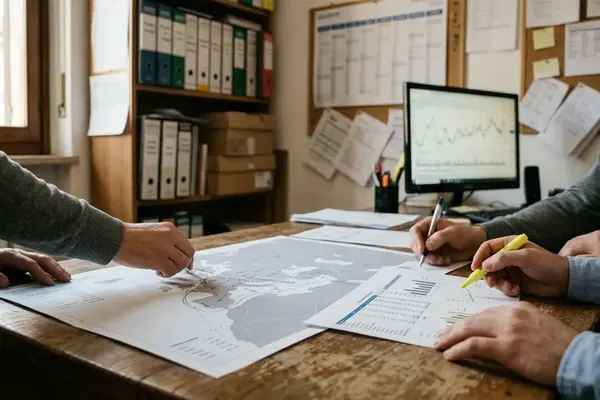
On a Monday morning in Modena, an export manager places three folders on the meeting table: France, Germany, USA. She does not open the one with the biggest headline market. She opens France, runs the tariff check against the product code, pulls up the short buyer list, and writes a single realistic follow-up date on the top sheet. Then she closes the folder and sets a calendar reminder for that date. The other two folders wait — not rejected, just not first.