1938: From Local Transport to Export Infrastructure
A Modena transport operator acquired its first motor-driven vehicle in 1938. That detail is small, but it gives the export story a useful starting point: before Modena could ship specialized automotive work abroad, local operators had to learn how to move goods reliably beyond nearby customers.
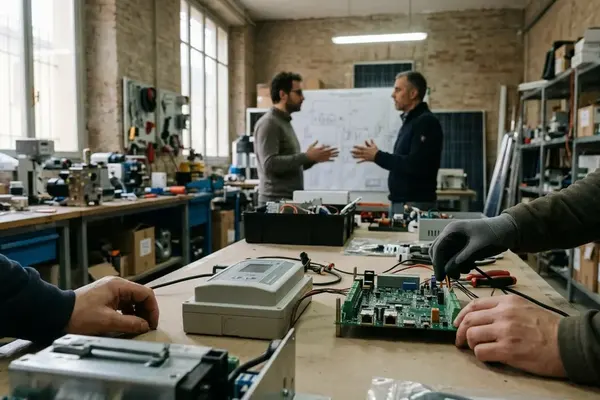
The district now reads as more than a premium automotive geography. It includes coachbuilding, motors, braking systems, engines, rapid prototyping, aftermarket parts, materials, and logistics services. A buyer who sees only prestige vehicles misses the working infrastructure behind the export offer.
The practical question is sharper: can a specialized workshop become part of an export-ready chain? The answer depends on quality evidence, component fit, documentation, delivery control, and technical support after the goods cross a border.
Article Focus
- How Modena’s fragmented automotive capabilities can be read as a supply system.
- Which export signals matter in coachbuilding, motors, brakes, engines, prototyping, parts, and wheels.
- How logistics execution changes the buyer’s risk profile.
- A worked screening matrix for a European commercial-vehicle buyer.
Turning Specialized Workshops into Export Capacity
International buyers often ask one direct question: who can deliver a compatible, documented, repeatable component on time?
Modena does not always answer that question through one visible product line. Its export-relevant functions sit across bus manufacturing, exhaust systems, DC motors, wheels, cabin filters, hydraulic brakes, foundry work, prototyping, and shipment management. Carrozzeria Barbi S.p.A. may matter for coachbuilding. BEST MOTOR SRL may matter for DC motors. SAFIM SPA may matter for hydraulic braking components. C.R.P. Meccanica may matter for rapid prototyping materials. Gazzotti or Artoni may matter when the goods need controlled movement.
The systemic challenge is not lack of capability. It is translation. A procurement team in Germany, the Netherlands, Sweden, France, Denmark, or a buyer comparing suppliers near Fiorano Modenese (MO) and Carpi (MO) still has to connect separate technical files into one operating decision.
Warning: A premium automotive geography does not automatically solve export readiness; the buyer still has to verify component compatibility, documentation, and delivery control.
That is where screening discipline helps. Buyers should ask for repeatable quality evidence, platform compatibility, cross-border technical support, and delivery proof before treating a supplier as export-ready.
Reading Modena as a Connected Supply System
A directory-style list hides the operational chain. A functional map exposes it.
For export screening, Modena’s offer works better when grouped by vehicle platforms, power and motion systems, structural components, rapid prototyping, maintenance parts, and logistics execution. This structure tells a buyer whether a supplier solves one component need, supports a vehicle platform, or contributes to an end-to-end delivery chain.
Intermodal logistics provides the bridge between production and delivery. Artoni’s swap bodies, or casse mobili, support road, rail, and sea movements. POD signature imaging and COD management reduce delivery uncertainty at the point where technical suitability meets payment and receipt control.
One historical logistics profile also records a refrigerated terminal acquisition in Trieste in 2002. That matters as a port-linked capability marker, not as a district-wide claim about refrigerated terminal access.
Export reading: The strongest export map starts with function, then attaches supplier evidence to each function.
Vehicle Platforms: Coachbuilding, Buses, and Commercial Transport
Carrozzeria Barbi S.p.A. is the anchor case for platform-level reading. Its coach references include Genesis HD and Genesis HDH, with a 12-meter Genesis HD configuration as a concrete product point for buyer review.
The export signals sit in the build details. Volvo chassis supply gives the buyer a chassis reference. Stainless steel vehicle trunks point to durability in storage compartments. Electro-galvanized sheet supports corrosion prevention. Cataphoresis treatment for aluminum doors and hatches adds a coating-process signal. High-resistance steel in impact-exposed structural parts gives the questionnaire team a material point to verify.
Optional onboard TFT monitors belong in a different category. They matter as buyer-facing equipment features, not as evidence of structural quality.
The company obtained UNI EN ISO 9001 certification in July 2000. That date is useful because it ties the quality-management claim to a specific milestone. It should not drift into a blanket statement about unrelated suppliers.
Buyer check: Ask for the certification date, scope, and current status. Do not assume ISO 9002 or another quality system applies unless the supplier file states it.
Power, Motion, and Control Components for Export Buyers
Motors, brakes, and engines belong in the same buyer screen because they affect motion, control, uptime, and serviceability.
BEST MOTOR SRL, founded in 1990, fits the DC motor category. Its relevant capability set includes S.E.M. technology, Class H insulation, permanent magnet gearmotors, and electropumps. For a buyer sourcing for forklifts, commercial vehicles, agricultural trailers, industrial vehicles, or machinery, these terms belong in the technical compatibility review rather than the marketing file.
SAFIM SPA, founded in 1976, belongs in the hydraulic braking component screen. The use cases connect to commercial and industrial vehicles, where brake integration and support matter more than a generic parts catalogue.
HATZ Italia brings professional machinery engine references into the same review. US-EPA and EU 97/68 CE references, together with EUROMOT recognition as product-related compliance markers, give buyers a compliance vocabulary to check against machinery requirements.
Distribution context matters, but it needs careful reading. BEST MOTOR works with ATECH Gmbh in Germany and S.P.I. in the Netherlands. SAFIM has distributor references that include HY-BROMS KB in Sweden and S.A.M.I in France. The service-route implication follows from these company-profile references; one catch: a distributor reference in Germany, the Netherlands, Sweden, France, or Denmark indicates a possible service route in that market, not universal European coverage or automatic compatibility with every vehicle platform.
Rapid Prototyping and Racing-Grade Precision as Export Differentiators
In export sourcing, prototyping reduces development-cycle risk. It lets a buyer test a part, inspect a model, or validate a material path before committing to a wider order.
C.R.P. Meccanica and CRP Technology are useful cases because the capability is not limited to machining language. One Modena advanced-materials profile records Selective Laser Sintering materials research beginning in 1996. The technology set includes Selective Laser Sintering, carbon-based or composite Windform materials, and Titanium Rapid Casting.
SCP Srl adds another rapid prototyping path in the Motor-Valley context. Active there since 2010, it uses SLA, SLS, and DMLS for aesthetic and functional models. That distinction matters: an aesthetic model may support approval and fit checks, while a functional model has to survive a different level of scrutiny.
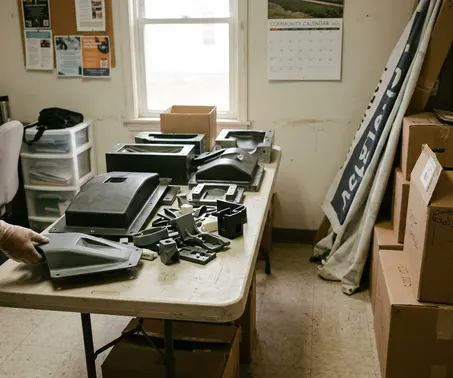
C.P.C. Modelleria Meccanica Srl extends the picture into carbon fiber lamination, resin foundry models, metal foundry models, CNC machining, and applications connected to F1 and Moto GP sectors. ALM and Aspect references should be treated as sector or partner context from company profiles, not as blanket qualification evidence.
Aftermarket, Spare Parts, and Materials: The Long Tail of Export Demand
Finished vehicles attract attention. Replacement demand often keeps the export relationship alive.
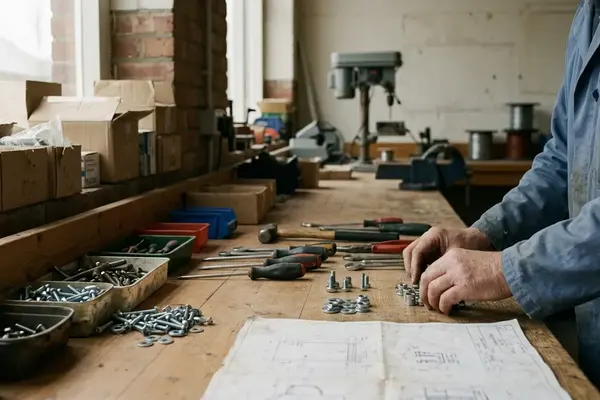
FAMAC Srl and Famac Snc show how Modena’s offer extends into vintage restoration and maintenance parts. Their Fiat 500-focused components include polyamide hubcaps, hard tops, fabric tops, under-fender components, preformed carpets, glazing, and soundproofing. For a restoration buyer, the need is not only availability. The part has to fit, ship safely, and match the intended vehicle use.
F.I.R. Srl, founded in 1985, belongs to the industrial wheel and material screen. Its materials include Polyamide 6, polyurethane-coated Superlan wheels, Tecnothane rollers, fiberglass-reinforced Nylon HT, asbestos-free phenolic high-temperature wheels, and rubber-on-polyamide Nylgom designs.
Agricultural spare parts add another demand line. Compatibility references include Fiat Agri and Laverda applications. One agricultural spare-parts profile dates to 1962, and a Data Processing Center introduced in 1974 provides an early warehouse-management milestone. For buyers, those dated markers help separate a documented parts operation from a loose trading offer.
Logistics Execution: From Factory Gate to International Buyer
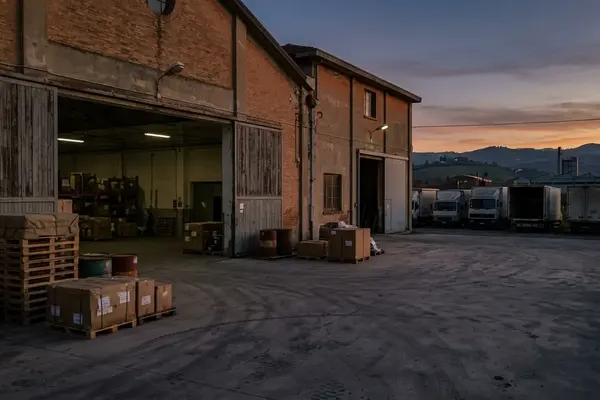
Before the shipment moves, the buyer has a technical order. During execution, that order becomes a documentation, handling, payment, and timing problem. The outcome depends on logistics discipline as much as product specification.
Artoni Trasporti illustrates this operating layer through swap bodies, POD signature imaging, COD automation, Expedit or Artoni Urgente services, and large-scale retail logistics. These are not slogans. They are control points: how the load moves, how receipt gets recorded, how payment-on-delivery is handled, and how urgent shipments receive priority.
Casa di Spedizioni Gazzotti SPA adds specialization. Its profile includes hazardous goods transport, coil carriers, maxi-volume vehicle bodies, a Sassuolo-area headquarters, and more than 50 years of company operation. For automotive and machinery buyers, hazardous classification, oversized bodies, and coil handling can decide whether a technically suitable supplier can actually deliver.
Barsan Italia SRL gives the bonded-warehousing and just-in-time case. Established in Italy in 1999 as part of Barsan Global Logistics, it moved to owned property in Modena in 2005. That timeline gives the buyer temporal context for the local operation rather than a bare parent-group affiliation.
Results: What the Export Capability Map Shows
The evidence does not support a ranking of Modena firms, and this guide does not attempt one. Within the documented company-profile facts available here, the stronger conclusion is operational: Modena’s export capacity appears through connected capability breadth and dated milestones.
The map includes complete coaches, commercial vehicle equipment, DC motors, hydraulic braking systems, professional machinery engines, advanced prototyping materials, vintage parts, industrial wheels, agricultural spare parts, bonded warehousing, urgent delivery, hazardous goods transport, groupage, and intermodal movement.
The dated points are useful because they can be checked in supplier qualification files: UNI EN ISO 9001 certification in July 2000 for the coachbuilder, BEST MOTOR SRL founded in 1990, SAFIM SPA founded in 1976, F.I.R. Srl founded in 1985, and an agricultural spare-parts supplier established in 1962.