Modena’s agri-food supply chain is the connected system of agricultural producers, processors, protected-origin consortia, packaging operators, logistics providers, exporters, and institutional support bodies that turn local food know-how into tradable products. Modena is internationally recognizable for a few iconic foods. However, export strength depends on documentation, repeatability, shelf-life, certification, and channel fit.
A procurement officer views regional specialties differently than a culinary tourist. The gap between a famous local name and a successful international shipment is bridged by operational execution. The following seven export strengths and market signals can help buyers, institutions, and local firms evaluate supply chain readiness.

Criteria for Selection: How the Seven Signals Were Chosen
Each item on this list was selected for export relevance, institutional recognizability, buyer-facing differentiation, and operational visibility in Modena’s agri-food ecosystem. The selection filters prioritize protected designation status, shelf-stability or cold-chain readiness, role in premium positioning, suitability for specialty retail or foodservice, and connection to broader Emilia-Romagna production systems.
While these seven signals provide a framework for due diligence, they function strictly as market-reading categories specific to this regional context rather than estimates of export value or sector rankings. Primary-source checks for any of these categories should include the EU Access2Markets trade requirements database for destination-market rules and official product specifications from consortia or public registers.
1. Parmigiano Reggiano and Dairy Traceability
Parmigiano Reggiano PDO acts as a high-recognition anchor for Modena’s agri-food reputation. The production area extends beyond the province, creating an interprovincial network of dairies and maturation facilities. PDO compliance depends entirely on official production-area and specification rules, not on a generic Italian hard cheese description.
Buyers look for traceability, maturation profile, cutting and packaging format, temperature management, and proof of origin. Commercial formats separate into whole wheels, fixed-weight portions, variable-weight portions, grated cheese, and foodservice blocks or bags. Maturation is a buyer-facing variable—requests often distinguish younger table-cheese profiles from longer-aged profiles used for premium retail or gastronomy.
2. Aceto Balsamico di Modena and Shelf-Stable Premium Demand
Aceto Balsamico di Modena PGI is one of the clearest export-facing identity products associated with the province. It travels well commercially due to shelf-stable formats, premium gifting potential, retail visibility, and flexible use in restaurants, delicatessens, and home cooking.
The buyer review focuses heavily on denomination, ingredient presentation, bottle size, closure, carton strength, labeling language, and private-label rules. Official PGI rules distinguish the protected denomination from traditional balsamic categories and from generic condiment-style products. A shelf-stable balsamic vinegar offer can appear export-ready on logistics grounds but still fail buyer review if the denomination, ingredient presentation, or private-label wording blurs PGI and non-PGI products. For premium retail, buyers compare glass bottle presentation, gift packaging, tasting notes, and whether the product is positioned for everyday cooking or gifting.
3. Lambrusco and the Return of Regional Wine Specificity
Lambrusco, including Modena-linked denominations, represents a category where regional specificity and food-pairing use are central to export positioning. The useful export question is whether the supplier can explain denomination, style, service occasion, and food-pairing logic to a foreign distributor.
Buyer checks include denomination, sparkling format, residual sugar style, alcohol labeling, bottle closure, case configuration, temperature exposure during transport, and importer compliance obligations. Channel education matters where the category is still associated with outdated sweet-wine stereotypes rather than regional sparkling red styles. Typical positioning cues include chilled service, lower-formality occasions, cured-meat pairings, and menus built around rich Emilia-Romagna dishes.
4. Cured Meats and Traditional Specialties with Regulatory Sensitivity
Prosciutto di Modena PDO, Zampone Modena PGI, and Cotechino Modena PGI serve as examples of meat-based products with strong cultural identity. These products support premium regional assortments, but they face higher regulatory complexity than shelf-stable condiments. The decision path starts with import eligibility before price, promotion, or taste.
Documentation checks include health certificates, approved establishments, permitted ingredients, heat treatment or curing status, packaging integrity, shelf-life evidence, and destination-market meat import rules. A cured-meat specialty that is acceptable in one destination market may be delayed or blocked in another because animal-origin import rules depend on establishment approval, processing status, certificates, and local admissibility lists. A pre-cooked, ambient-stable format and a chilled fresh format face different logistics and border-control treatment even when the product name is similar.
5. Vignola Fruit, Preserves, and Seasonal Value Chains
Ciliegia di Vignola PGI and related fruit-processing activity show how Modena’s agri-food strength extends beyond dairy, vinegar, and wine. The export reading separates fresh seasonal movement from processed fruit value chains.
Fresh fruit requires timing, quality grading, and logistics discipline. Fresh-fruit buyer cues include variety, harvest window, grading method, temperature handling, residue compliance, packaging format, and shelf-life at arrival. Processed routes include preserves, semi-processed fruit, fillings, toppings, ingredients for bakery, gelato applications, and foodservice preparations. These processed formats extend seasonal value and simplify export logistics—a critical advantage for distant markets.
6. Processing, Packaging, and Private-Label Capability
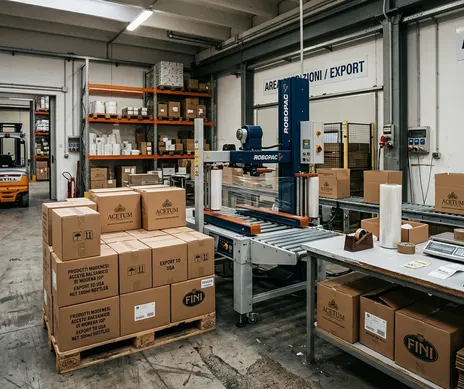
This item moves beyond finished products to the enabling layer: bottling, portioning, labeling, packaging, quality systems, and product adaptation. Logistics audits of Emilia-Romagna export hubs demonstrate the necessity of this operational layer. Many buyers need compliant formats, multilingual labels, palletization standards, barcode readiness, and private-label flexibility.
Buyer-facing capabilities to request include compliant nutritional panels, carton and pallet specifications, lot coding, shelf-life coding, allergen declarations, and private-label artwork handling. Ask, per sector experience, for non-confidential examples from the last 18 to 36 months showing adapted packaging or labeling for comparable destination markets. For repeat orders, confirm whether the supplier can keep the same format, carton count, lot traceability method, and loading requirements across shipments. A famous product name is not enough for procurement: a buyer may need fixed-weight formats, multilingual labels, pallet specifications, lot traceability, and proof that the same execution can be repeated on a second shipment.
7. Institutional and Fair Signals
Read institutions as evidence amplifiers, not proof by themselves. Chambers, consortia, regional bodies, export helpdesks, and sector fair participation matter when they connect buyers to current documentation.
Useful buyer-facing evidence includes export catalogues, multilingual technical sheets, certifications, consortia references, sample policies, export contact names, and logistics contacts. A supplier profile is stronger, per sector experience, when technical sheets, certificates, and product claims have been reviewed or refreshed within the last 12 to 24 months. Institutional promotion should be cross-checked against product documentation rather than treated as a substitute for due diligence.
How to Read the Signals
Synthesize the list into a decision sequence. First establish product identity, then regulatory feasibility, then logistics model, then channel fit, and finally proof of execution from the supplier.
The evaluation sequence requires strict adherence to order: product identity, protected denomination, import eligibility, shelf-life or cold-chain need, target channel, labeling requirements, documentation status, and evidence from previous comparable shipments.
Operational takeaway: Modena’s strongest export opportunities emerge where recognized regional products are matched with clear documentation and market-specific formats.
Practical check: Compare two or three product categories against the same destination-market checklist before choosing which category to promote.
Next Steps for Market Entry
Build a market-entry checklist using the following fields: product category, protected denomination, target buyer type, documentation status, logistics requirement, labeling needs, sample policy, and market-entry risk. Choose one target market, select one product category from the list above, and verify the specific documentation and import requirements for that exact combination before contacting any local suppliers or buyers.