Why Mirandola Became a Biomedical District
Mirandola’s biomedical identity did not appear from a single factory. It emerged from a local accumulation of plastics know-how, subcontracting relationships, recurring clinical demand, and entrepreneurial spin-offs. Read Mirandola as a layered industrial formation. Isolated capabilities evolved into a dense, interdependent network.
The ecosystem encompasses manufacturers, component suppliers, packaging firms, machine builders, testing services, logistics operators, and local institutional support. This density allows specialized knowledge to circulate rapidly between facilities.
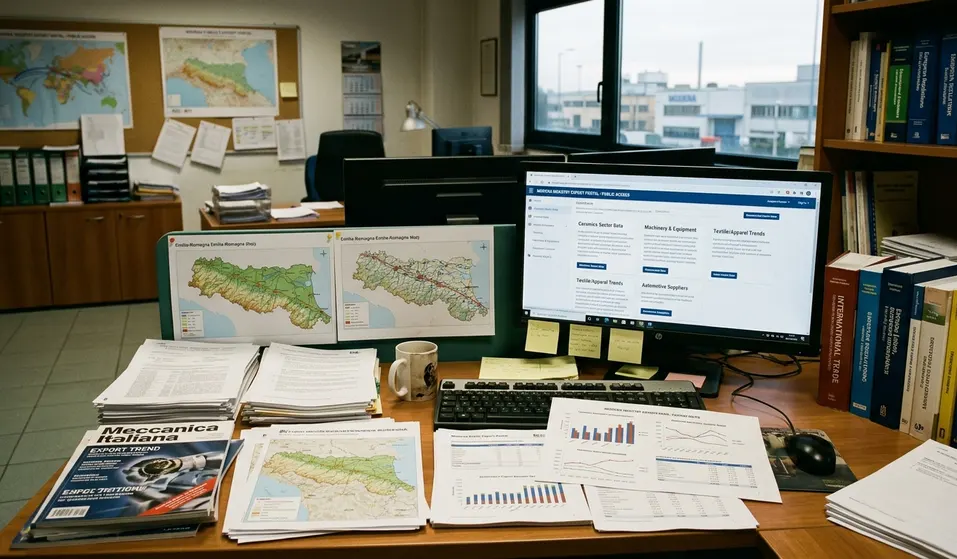
The 2012 Emilia earthquakes served as a severe supply-chain stress test. Factory access, equipment relocation, clean areas, staff continuity, and customer communication all became operational issues simultaneously. The district's response demonstrated the resilience of its interconnected structure. For export readers, the useful unit of analysis extends beyond the municipality to the wider Modena and Emilia-Romagna manufacturing environment around devices, components, packaging, machinery, testing, logistics, and institutional support.
Start With the Value Chain, Not the Company Brochure
Start the investigation by separating finished-device producers from upstream and adjacent functions. The district breaks down into functional layers: disposable components, tubing and connectors, sterile packaging, cleanroom services, equipment maintenance, regulatory support, and export logistics.
A strong district reduces search costs, but every supplier still requires individual verification.
Practical point: A component specialist may be excellent for tubing or connectors yet unsuitable as a finished-device exporter if it lacks distributor management, market-specific labeling, or post-market complaint procedures.
A first-pass supplier map can be built in one working session of roughly 90 to 120 minutes using four fields: what the firm makes, what it outsources, which process steps are critical, and which quality or regulatory evidence applies to the product category. For each candidate supplier, record the legal entity name, production site location, product family, outsourced processes, certification scope, and the contact responsible for technical documentation.
How to Read Specialization and Export Readiness
Assess export readiness by moving from product description to transaction evidence. Examine a Mirandola company’s positioning through its product family, clinical or technical use case, buyer type, production scale, customization ability, and after-sales requirements.
Distinguish between export interest and export readiness. The latter requires documentation language, regulatory files, distributor management, complaint handling, lead times, Incoterms familiarity, and market-specific labeling.
Use a three-supplier comparison before judging price. Ask each firm for the same product scope, packaging assumption, sterilization position if relevant, documentation language, lead-time basis, Incoterms comfort, and service escalation path. Two quotations for the same disposable device can differ because one includes validated packaging, translated instructions, sterilization documentation, and complaint escalation, while another covers only the physical product.
For a 2024-2025 supplier screen, request evidence from recent audits or customer qualifications where the supplier can disclose it without breaching confidentiality.
Quality Signals: What to Verify Before You Trust Them
Treat certificates as starting signals, then trace them back to product-level evidence. The review should move from the visible document to its scope, issuing body, named legal entity, validity period, and underlying technical files.
Understand the difference between visible trust signals and verifiable evidence. You must look for audit history, batch traceability, sterilization records, supplier controls, and corrective-action processes. Medical-device rules vary by jurisdiction. European compliance evidence can support due diligence, but it does not automatically satisfy every destination-market requirement for registration, labeling, importer responsibility, vigilance, or post-market obligations.
Warning: A Mirandola address is not proof that a supplier can serve a regulated destination market; the decisive evidence is tied to the legal entity, product scope, documentation, and controls.
A practical document request can include the applicable quality-system certificate—such as ISO 9001 or ISO 9002 where historically relevant to specific component tiers, declaration of conformity where relevant, product data sheet, instructions for use, packaging specification, traceability description, and complaint-handling procedure. Check whether the certificate covers the exact product family being purchased, the production site involved, and the legal entity signing the commercial contract.
Use the District Context as Evidence, Not Decoration
Use the district context as corroborating evidence. The wider Modena and Emilia-Romagna setting provides a foundation of manufacturing culture, mechanical skills, plastics processing, packaging competence, and logistics links. Proximity to other industrial hubs—such as the ceramics expertise in Fiorano Modenese (MO) or the textile heritage in Carpi (MO), demonstrates a regional capacity for specialized, high-volume production and cross-pollination of mechanical engineering solutions.
Public-interest institutions add critical context. Chambers of commerce, regional development bodies, universities, hospitals, and trade associations provide orientation, contacts, training, and export-support programmes. The necessity of local orientation remains high—regional economic mapping maintained since the district's post-2012 recovery phase confirms as much.
Institutional contacts are most useful at the orientation stage. They excel at identifying relevant subsectors, explaining local capability, pointing to training, and helping visitors understand the difference between a producer, subcontractor, service provider, and intermediary. Programme availability, eligibility rules, and institutional contact points should be rechecked for the specific calendar period of the visit or procurement project.
Build a One-Day Fieldwork Plan Before You Decide
Convert the district visit into a decision sequence. A practical itinerary structures the day to capture both technical and commercial realities.
A one-day visit can run from 09:00 to 17:30:
- 09:00 to 10:00: District briefing
- 10:30 to 12:00: First supplier visit
- 13:30 to 15:00: Second supplier visit
- 15:30 to 16:30: Packaging or logistics discussion
- 16:45 to 17:30: Decision memo
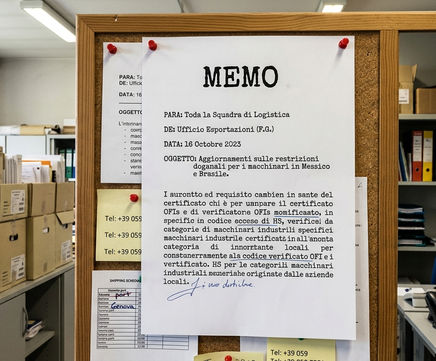
The decision memo should use four columns: product fit, evidence received, open risks, and next action. Record what was observed directly on the factory floor versus what was stated in meeting rooms.
At 17:30, the export manager steps out of a low-slung manufacturing facility on Via Statale Sud, the late afternoon sun reflecting off the loading bays. They place a set of sealed, sterile sample packs into their briefcase, alongside a notebook filled with specific audit questions and a four-column decision memo that narrows a sprawling industrial district down to a precise, actionable shortlist.