What Counts as a Technology and Energy Services Export in Modena
A technology and energy services export, in this Modena profile, means any Modena-based capability that can be sold, licensed, installed, maintained, integrated, or specified across borders.
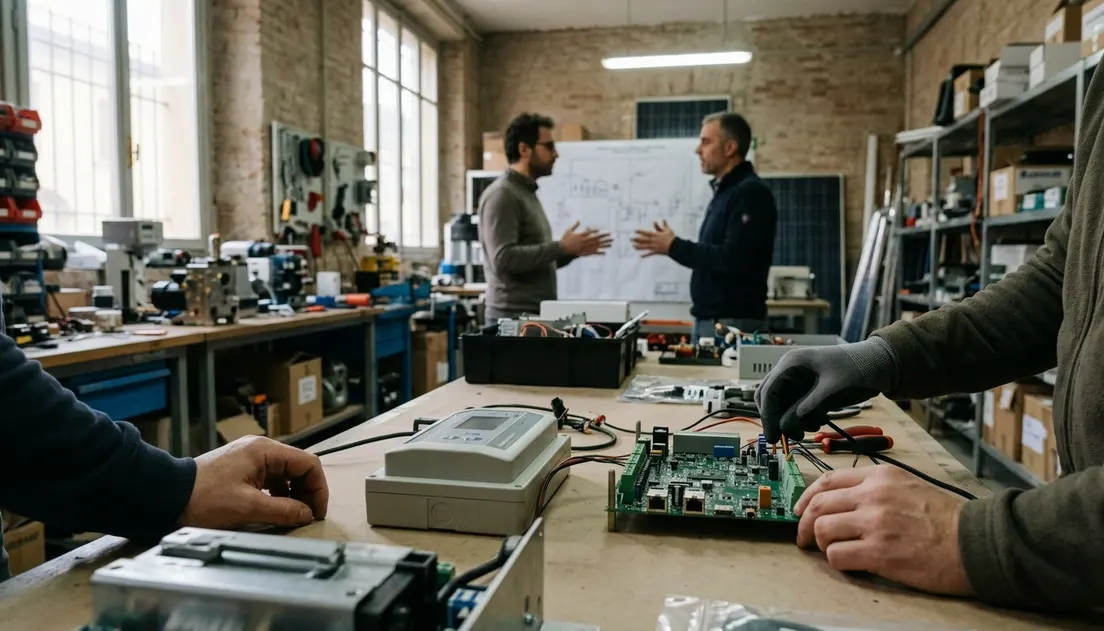
That definition matters. If I reduce export capacity to boxes leaving a warehouse, I miss half the machinery of internationalisation: software configuration, plant integration, maintenance roles, standards intelligence, testing equipment, installation know-how, and technical documentation. Those are not side notes. For many buyers, they decide whether a system can work outside Italy at all.
The case-study frame here covers industrial technologies, energy and water systems, telecom testing, software, technical documentation, filtration, electronics, materials, and service infrastructure. It is a profile of named capabilities from the supplied source set, not a census of every technology exporter in the province.
The tension is simple. Modena has a strong offer, but international buyers rarely meet it as one tidy category. They meet specialised firms, each speaking from its own trade: boiler systems, network testing, cabin filters, water purification, reflective films, cybersecurity, industrial digitalisation, or compliance documentation.
That fragmentation is not a weakness in production. It is a weakness in discovery.
Challenge: A Strong Offer Hidden Behind Fragmented Specialisms
A buyer looking for “energy equipment” could miss CPL CONCORDIA SOC. COOP., because the capability is not only equipment. It includes energy and utility services and gas and water network management. A buyer looking for “automotive parts” could miss AIR TOP ITALIA SRL, even where the relevant need is cabin-air filtration and material performance.
The same pattern appears in telecom. ADVANCED TELECOM SYSTEMS SPA sits in the network testing field, while I-TECH S.R.L. belongs to industrial digitalisation and INFODOC S.R.L. to standards intelligence. Alphabetical lists keep them apart. Buyer problems do not.
The stakeholder problem
Local institutions and trade associations need language that travels better than company names or industrial codes. A procurement officer in another country does not begin with the local directory structure. She begins with a failure point: poor network performance, outdated plant control, water quality, compressed certification timelines, spare-parts risk, or unclear compliance evidence.
That is the first-principles view: describe the sector by the problem it solves.
Warning: Grouping Modena firms only by industrial code can separate telecom testing, electronics assembly, industrial software, cybersecurity tools, and legacy systems maintenance even when the buyer’s real need is one integrated plant or network-performance solution.
This is where an export profile has to do more than decorate a territory. It must make the buying path legible.
Solution: Read the Sector as Four Export Capability Layers
I use four capability layers because international buyers usually work in sequence: application problem first, proof signal second, integration and after-sales third. The layer model makes that sequence visible.
Layer 1: energy, water, environmental, and filtration systems
This layer groups CPL Concordia, MC Mescoli Caldaie, EcoWater Systems Italia, Vaneton, and Air Top Italia. The common thread is environmental performance at the level of infrastructure, equipment, treatment, or air quality.
It is not one product family. It is one buyer need: make a technical environment cleaner, safer, more controllable, or easier to maintain.
Layer 2: telecom, electronics, cybersecurity, and industrial IT
This layer includes Advanced Telecom Systems, AUTRONIC, Techne Security, Bredi, HARS, I-Tech, and ENEAS Informatica. Here the exportable value sits in testing, electronic systems, software infrastructure, security, and industrial digitalisation.
For buyers, this is the layer to open when the question is not “which machine?” but “which system proves, controls, protects, or connects the machine?”
Layer 3 and Layer 4: materials, media, and enabling services
Layer 3 covers industrial materials, packaging, reflective films, ceramics, printing, and media production: Albertazzi G., IRC International Reflective Company, Mineral, Golinelli Industrie Grafiche, and Lorri Mediaservice.
Layer 4 covers enabling services for market entry and technology adoption: Infodoc, DemoCenter SIPE, Globe, Factotum, Auxilia, Artigiana Design, and DB di Daniele Burgoni. This layer often gets underrated because it does not always look like “technology” at first glance. In export work, it can be the part that keeps the technical offer usable.
Layer One: Energy, Water, and Environmental Systems
The first layer starts with infrastructure-type applications: gas and water network management, heating systems, water purification, and cabin-air filtration. This is the layer where buyer need often comes from regulation, operating cost, health, or continuity of service.
CPL Concordia: utility management as exportable know-how
CPL Concordia is linked to STAI for gas and water network management. That matters because a buyer may not be searching for a single device. The buyer may need a system-management capability that sits across meters, networks, maintenance routines, and service accountability.
CPL Concordia’s “Third Manager” activity is associated with Presidential Decree no. 412. Its ISO 9001 certification context involves Det Norske Veritas. Those are useful trust signals because they show the firm has been described through recognised management and compliance frames, not only commercial language.
MC Mescoli Caldaie: heating technology with production depth
MC Mescoli Caldaie belongs in this layer through heating systems. The technical vocabulary is specific: gasification, inverted flame, aspiration, and multifuel boiler technologies.
The supplied record gives a production-history signal of more than 30 years. I would not stretch that into a performance claim. Longevity tells a buyer that the firm has operating experience; it does not, by itself, prove efficiency, local approval, or suitability for a specific fuel regime.
EcoWater Systems Italia: water treatment as controlled service
EcoWater Systems Italia brings the water-purification side into focus through reverse osmosis, NOVRAM-controlled regeneration, Digit consumption tracking, CRISMA, and AUTOTROL valves. The source record also states a presence of more than 20 years in water purification.
The practical point is control. Water treatment buyers need more than a vessel and a valve. They need regeneration logic, consumption visibility, component reliability, and documentation that can cross from installer to facility manager without losing meaning.
Layer Two: Telecom, Electronics, and Software Infrastructure
This layer begins with proof. Before a network or industrial system is trusted, it has to be tested, simulated, secured, and supported.
Advanced Telecom Systems: testing before deployment
In the supplied records, Advanced Telecom Systems was founded on December 29, 1997, obtained ISO 9002 certification in December 1999, and is linked to a technology partnership with Spirent Communications. That combination gives an international buyer several angles for due diligence: date of establishment, quality-system context, and named technology relationship.
The capability set is unusually concrete. SmartBits supports IP network load and performance testing. AX/4000 is associated with benchmarks. Emutel covers ISDN and analogue simulation. NQMS addresses voice quality. RMON2 and Level 7 content switching place the firm inside the language of network visibility and traffic behaviour.
This is not generic IT. It is test infrastructure for buyers who need to know what a network will do under pressure.
AUTRONIC: electronics manufacturing for applied systems
AUTRONIC is described in the supplied record as founded in 1998 and as an electronics systems manufacturer using SMD production, ATE in-circuit testing, and CAE for hardware and software development. The automotive angle is specific: LPG or methane applications.
That specificity helps. In export screening, “electronics” is too wide to be useful. SMD production, in-circuit testing, and CAE narrow the conversation to manufacturing process, verification method, and development environment.
Software, cybersecurity, and compliance edges
Techne Security, Bredi, HARS, I-Tech, and ENEAS Informatica sit in the surrounding software and industrial IT field. The source set places ENEAS Informatica’s market entry in 1988, which gives the layer a longer software-service horizon than a buyer might expect from a territory better known abroad for physical manufacturing.
Electronics buyers should also keep destination rules in view. Where electrical and electronic equipment enters the European market, the RoHS Directive can become part of the compliance conversation, alongside product-specific standards and buyer specifications.
Layer Three: Materials, Industrial Media, and Buyer-Facing Services
Modena’s technology export profile is a layered mix of systems, materials, packaging, reflective surfaces, printing, media, and documentation that travel across borders. Often, they travel earlier in the buyer relationship, because they shape how a product is preserved, presented, specified, or understood.
Albertazzi G. S.p.A.: packaging as technical performance
Albertazzi G. S.p.A. was founded in 1938 and works here as the flexible-packaging case. Its capabilities include flexography, rotogravure, coextrusion, and atmosphere modification for food preservation.
Packaging can look ordinary until the application becomes specific. Food preservation changes the question. Then the buyer is no longer purchasing a printed wrapper; the buyer is specifying a material and process combination that must protect shelf life, handling, brand presentation, and regulatory information.
IRC International Reflective Company: visibility as engineered material
IRC International Reflective Company is described through Corlite retroreflective films, Retrolux fabrics and transfers, 2D/3D hologram effects, and metallizing processes. Autoadesivi/IRC was established in 1981.
Here the exportable capability is surface behaviour. Visibility, reflection, transfer, and metallized effect are not decorative afterthoughts when they support safety, identification, anti-counterfeiting cues, or functional design.
Mineral, Golinelli, and Lorri Mediaservice: the supporting layer buyers notice late
Mineral S.r.l. brings a materials-analysis vocabulary: calcined alumina, zirconium oxide, XRF, XRD, laser granulometric analysis, and the LRM Industria testing relationship. Golinelli Industrie Grafiche, founded in 1951, and Lorri Mediaservice sit in the export-enabling media and printing space.
This is the layer buyers often notice late. The plant is selected. Packaging is not. The technical manual remains unclear. Market-entry material has not been adapted. Then the so-called support services become critical path.
Results: What the Case Reveals About Export Readiness
The result is not a claim about sales performance. The safer reading is this: Modena’s technology and energy services field shows repeated export-readiness patterns.
Those patterns include establishment depth, certification references, patent coverage, named technology partners, and named certification or qualification bodies. Albertazzi dates to 1938. Golinelli was founded in 1951. Autoadesivi/IRC was established in 1981. Infodoc was founded in 1984. ENEAS Informatica entered the market in 1988. Advanced Telecom Systems was founded in 1997. AUTRONIC was founded in 1998. Globe started in 1999.
Dates do not make a supplier suitable. They do create a traceable starting point.
Certification and qualification signals add another layer: ISO 9001, ISO 9002, Det Norske Veritas, SGS Italia, and Argenta SOA appear as named evidence in the supplied profile. Patent coverage for Zaffo active carbon mixture and a named technology partnership such as Spirent Communications point to still other forms of proof.
Export-readiness point: These signals indicate export-readiness characteristics, not guaranteed current capacity, pricing, lead time, or regulatory approval in every destination market.
This distinction keeps the profile honest. A certificate answers one question. A patent answers another. A partnership answers another. None of them replaces current technical datasheets, installation conditions, after-sales terms, or destination-market checks.
The practical impact for local stakeholders is clear: present capability evidence in the same order buyers use it. First application. Then proof. Then integration. Then service.
How Buyers and Local Stakeholders Should Use This Profile
Use the profile as a working sequence, not a directory.
Identify the application problem before searching by company name.
Match the requirement to one of the four capability layers: energy and environmental systems; telecom and software infrastructure; materials and media; enabling services.
Check the relevant proof signal: ISO 9001, ISO 9002, patent reference, named technology partner, testing relationship, qualification body, production history, or foundation date.
Request current documentation directly from the company before commercial negotiation.
Questions buyers should ask
For buyers, the due-diligence file should cover certifications, export references, language support, spare parts, after-sales service, applicable standards, installation requirements, and destination-market compliance. If the supplier will install or maintain a system abroad, ask who performs the work, which documents travel with the equipment, and which responsibilities remain local.
Practical step: Do not ask first for a catalogue. Ask for the latest technical datasheet, compliance evidence, service terms, and a short note on export support in your destination market.
How Modena companies and institutions can package the offer
For Modena companies and institutions, the stronger route is use-case packaging. Cleaner air. Network performance. Utility management. Water treatment. Industrial automation. Secure software. Packaging. Accessibility. Technical documentation.
That language travels better from Fiorano Modenese (MO) to a foreign purchasing desk, or from a contact in Carpi (MO) to a standards team reviewing market entry. It starts where the buyer starts: with the job to be done.
Shortlist three Modena companies from the relevant capability layer and request updated technical datasheets, compliance evidence, and export support terms before opening commercial negotiations.