What Is at Stake When a Buyer Chooses Modena Machinery?
An overseas buyer selecting production equipment from Modena is committing plant uptime, integration work, service access, and long-term operating risk to a supplier they may not yet know well. Get the reading right, and the district delivers repeatable machines with people who can adapt them. Read it wrong, and the buyer loses weeks to poor integration, unclear responsibilities, and a supplier structure they never understood.
As a case study, Modena shows how a local mechanical engineering base became export-relevant through accumulated know-how, specialised firms, and institutional support that helps make that capability legible abroad.
The pattern is clear: fragmented global demand for machinery that must perform in someone else's plant, answered by district-based capability paired with robotised production. The results are not invented export totals but export-readiness signals a buyer can request and verify.
A lower-priced machine can become the more expensive option if commissioning support is weak, spare parts are undefined, or integration responsibilities are left outside the contract.
The Challenge: Global Demand Is Technical, Fragmented, and Risk-Sensitive
Machinery exports are hard because the buyer's real requirement extends far past the purchase order. Performance has to match a defined process. Commissioning support has to arrive on time. Spare parts have to be available years later. Compliance files have to exist in a usable form. And the equipment has to adapt to the buyer's plant conditions, not the manufacturer's ideal test bench.
For Modena equipment manufacturers, the problem is competitive positioning. They must sell internationally without letting their machines be reduced to commodity pricing, because commodity pricing erases exactly the customisation and service that make the district worth choosing.
The buyer's exposure is operational, not only financial. Downtime, weak integration, thin after-sales cover, or unsuitable automation can each outweigh a lower sticker price. That is why a procurement file should separate its stages rather than collapse them into one transaction:
- Pre-order technical dialogue and application review
- Order confirmation with agreed specifications
- Factory testing against defined criteria
- Shipment preparation and packing
- Installation and commissioning
- Post-start-up support and escalation contacts
Origins: Why Pre-War Mechanical Know-How Still Matters
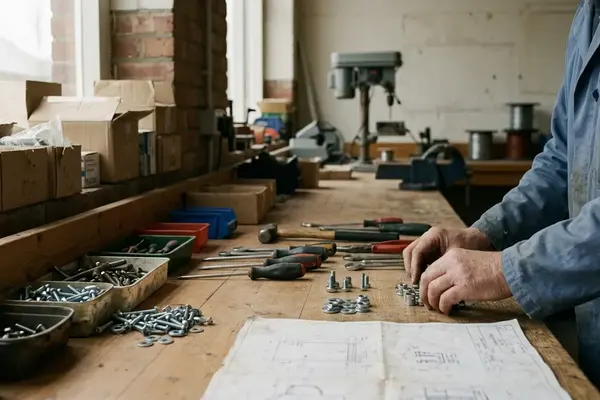
The local mechanical engineering sector did not appear with the current automation cycle. Its roots reach back to pre-war workshop capability, and that continuity matters more than it first appears.
Long-cycle skills accumulate slowly. Metalworking, machine repair, component adaptation, maintenance routines, supplier relationships, and the tacit learning that lives on a workshop floor cannot be installed overnight. Post-war years turned those workshop habits into supplier networks. Those networks, in turn, became the base that today's export evaluation draws on.
The historical argument has a limit worth stating plainly. Pre-war roots explain why capability persists across generations of firms; they do not prove that any single manufacturer today has strong documentation, current certifications, or export discipline. Continuity of the territory is one thing. The maturity of a specific supplier is another, and only supplier-level checks settle it.
The Solution: District Capability Meets Robotised Production
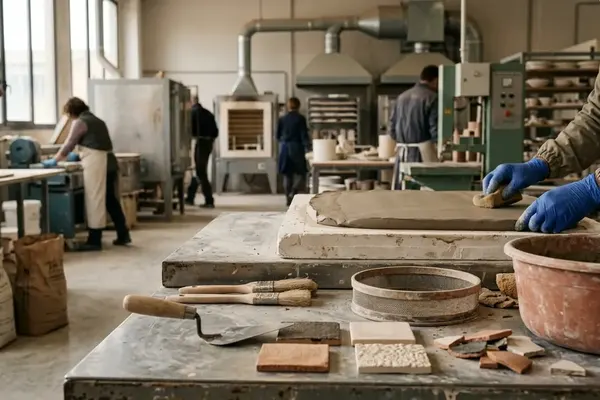
Robotised production is an advanced manufacturing technique that supports repeatability, precision, and controlled workflows. In a district serving demanding export markets, that control is the point: consistency, documentation, and delivery discipline travel better across borders than craft heroics do.
But automation is one layer, not the whole system. It sits inside a chain that a buyer can map end to end:
- Engineering design
- Component sourcing
- Production workflow
- Factory testing
- Packing and shipment
- Installation
- After-sales support
Within production itself, buyers should ask which steps are robotised and which stay manual. Automated machining, robotic handling, welding cells, and inspection routines behave differently from manual finishing and final adjustment. Each has its own error profile.
Robotised production is not automatically a quality guarantee; it becomes meaningful when the supplier can show which steps are automated, how deviations are checked, and how final acceptance is documented.
Meaningful quality evidence is concrete: inspection records, test protocols, tolerance declarations, conformity documentation, and traceability of critical components where it matters. Firms operating under recognised quality systems such as ISO 9001 tend to have this paperwork organised, though the presence of a certificate is a starting point for questions, not the end of them.
Pro Tip: Ask a shortlisted supplier to walk you through one recent machine step by step, from design through commissioning. A firm that can narrate its own process without gaps usually runs it well.
Local Support: Chamber of Commerce of Modena and PROMEC
Two institutions help a buyer read the territory. The Chamber of Commerce of Modena establishes regional economic context and business-information pathways. PROMEC, a local economic promotion body maintained as part of the internationalisation support network, connects to market-facing promotion and export channels.
For a buyer or a researcher, this infrastructure is orientation. It helps map sector priorities, local economic visibility, and the routes through which firms present themselves abroad. For exporters, it is a channel to align company profiles, technical sheets, sector narratives, and buyer presentations with recognised local support.
Institutional visibility through the Chamber of Commerce of Modena or PROMEC helps map the territory, but it does not certify that every equipment manufacturer has equal export maturity.
Treat these bodies as context providers, not as guarantors. They point you toward serious industrial districts around centres like Fiorano Modenese (MO) and Carpi (MO). They do not sign off on the automation level, documentation quality, or after-sales record of any individual firm.
How International Buyers Should Assess Modena Equipment Manufacturers
Comparing Modena engineering exports against other industrial machinery Italy suppliers works best as a due-diligence sequence rather than a feature checklist. Five areas carry most of the decision.
The five evaluation areas
- Technical fit — does the machine match the defined process and output condition?
- Customisation capacity, can the supplier adapt design to your plant?
- Production process control, is there evidence of repeatability and inspection?
- Export documentation, are manuals and compliance files available in your language?
- After-sales support, what response and spare-part commitments are contractual?
Questions that separate serious suppliers
Four questions tend to reveal maturity quickly: What applications has this machine already served? What commissioning support is available on site? Which spare-part timelines can be defined in the contract? Which manuals and compliance documents come in the buyer's language?
The nature of the purchase decides how deep the dialogue goes. Catalogue purchasing suits standard equipment needing little adaptation. Engineered purchasing demands technical dialogue, application review, integration planning, testing criteria, and clear responsibility allocation before any order is placed.
Results: What Export Readiness Looks Like in Practice
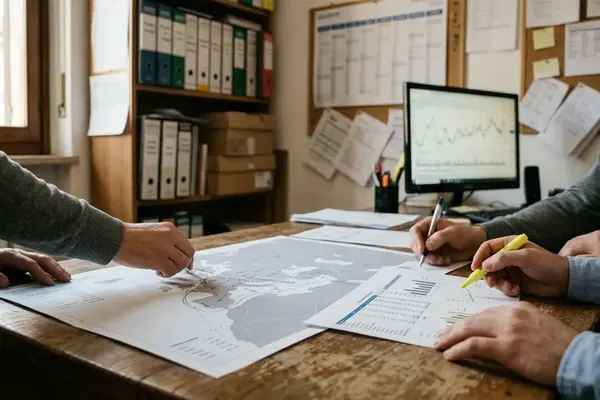
Because no verified district-wide figures exist in the source material, the honest measure of results is documentary, not statistical. Export readiness is what a firm can show, and what a buyer can request.
The signals are specific: international reference cases, multilingual technical sheets, service response commitments, conformity documentation, installation procedures, spare-part plans, and evidence of production process control. Assembled together, they form a compact evidence pack — a company profile, machine application examples, a quality process summary, an export logistics workflow, and an after-sales contact structure.
Recency matters here. Current reference material from recent buyer projects, updated technical sheets, and recent service workflows tell you more than legacy brochures. A firm that shows a project it delivered last year is describing its present capability, not its history.
Key Takeaway: Measure export readiness at the company or project level using documented evidence. Resist any district-wide percentage claim you cannot trace to a named source.
Limits of the Case: Where Buyers and Exporters Should Be Careful
District reputation is a useful filter and a poor conclusion. It narrows the field to a serious industrial territory; it does not tell you which firm inside that territory will keep your line running.
Do not assume uniform maturity. Two neighbouring manufacturers can differ sharply in automation level, documentation quality, certification status, and after-sales capability. The recurring failure points are predictable: unclear service terms, undocumented customisation, weak spare-part planning, incomplete installation responsibility, missing language versions, and vague acceptance-test criteria.
Warning: Modena district reputation can help you identify a serious industrial territory, but it cannot substitute for supplier-level due diligence on automation, documentation, certifications, delivery discipline, and after-sales capacity.
Protect the decision with a file. Preserve signed specifications, interface drawings, conformity declarations, agreed spare-part lists, commissioning responsibilities, and escalation contacts. Institutional references from the Chamber of Commerce of Modena and PROMEC belong in that file as context — never as a replacement for technical audits, contract review, or compliance checks.
Your Next Step: Build the One-Page Evidence Checklist
Turn this case study into a working document before you contact any supplier. A single page does the job on both sides. The buyer version records machine application, technical specifications, customisation scope, production controls, commissioning plan, spare parts, service contacts, and compliance documents. The exporter version mirrors it: technical sheet, case examples, process description, quality evidence, service terms, export logistics workflow, language availability, and institutional context where relevant.
Then do this: write down the three machinery requirements that cannot fail in your production line. Send that short list to each shortlisted Modena supplier and ask each one to prove — with documents, references, and contractual terms, exactly how those three requirements will be met. The suppliers who answer clearly are the ones worth a factory visit.