Why a 4-Star Residence Can Matter to Export Geography
International buyers and supply chain managers frequently ask how to interpret the physical footprint of a region before committing to a site visit. The practical task is mapping international business activity without defaulting to broad provincial industrial identities. That means reading supplied company, product, and facility facts as business-geography signals.
Residence Green Park 2 operates as a 4-star accommodation facility adjacent to the Mercure Campogalliano hotel complex. This adjacency provides a concrete place-based signal. The municipal lens focuses on hosting, supporting, and interpreting international business activity rather than ranking municipalities by export volume. This distinction separates operational municipal signals from broad provincial industrial identity.
Criteria for Selection: What Counts as a Municipal Export Signal
Exporters require reliable methods to screen partners and brief institutions. The response is a selection logic based entirely on verified signals present in source facts: named companies, product categories, catalogues, ownership roles, facility types, service features, and adjacency to business accommodation. The result is an actionable intelligence brief.
Centro Giochi Srl functions as a sector signal because the entity is identified as an educational aid specialist. Its product categories include aids linked to physical, sensorial, and linguistic development. Marik Spa serves as an ownership and hospitality signal because it is identified as the owner and proprietor of Residence Green Park 2. Quality management frameworks like ISO 9001 or ISO 9002 may accompany such facility verifications, though the primary signal remains the physical infrastructure.
While these specific facility and catalogue facts support municipal intelligence and buyer planning, they do not prove export turnover, market share, employment, or district-wide specialization.
Seven Municipal Intelligence Points for Exporters

Operational intelligence relies on specific, verifiable data points rather than generic municipality profiles. Each point below makes one supplied fact operational for buyer planning.
1. Campogalliano as a Visitor-Logistics Signal
Visitor logistics form the foundation of international trade missions. The signal comes from Residence Green Park 2 and its adjacency to the Mercure Campogalliano hotel complex.
2. Hospitality Ownership as Local Business Infrastructure
Understanding who controls local assets provides insight into business infrastructure. Here, the relevant fact is Marik Spa as the owner and proprietor of Residence Green Park 2.
3. Educational Aids as a Product-Category Signal
Specific product categories define the commercial capability of a municipality. This signal is anchored by Centro Giochi Srl and its focus on specialized educational tools.
4. Physical-Development Products for Buyer Segmentation
Physical-development products act as catalogue language that can guide buyer segmentation. A product catalogue category may matter differently to an education distributor, a school procurement office, a trade association, or a local economic development body.
5. Sensorial-Development Products for Specialist Procurement
Sensorial-development products serve as a signal for specialist educational procurement, not just general toys or classroom supplies. This distinction is critical for targeted international outreach.
6. Linguistic-Development Aids in Catalogue Positioning
Linguistic-development aids provide a distinct catalogue category. Buyers use these classifications to match local suppliers with international educational standards.
7. Adjacency to Established Business Accommodation
Physical proximity to established hubs can shape buyer itineraries — field reports from Fiorano Modenese (MO) point in the same direction. Adjacency helps international delegations plan meetings around the industrial area.
How Exporters Should Use This Municipal Map
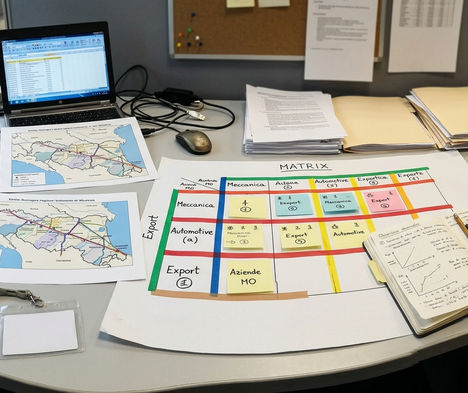
Before a visit, an exporter or buyer can verify a municipal lead. During the engagement phase, they can follow a specific workflow to ensure the data translates into practical itineraries. The outcome is a simple matrix with columns for company, municipality, category, facility or service, buyer relevance, and verification status.
- Identify the municipality connected to the company, facility, or service signal.
- Confirm the legal entity before using the signal in a market brief.
- Record the product or service category, such as educational aids or an accommodation facility.
- Note buyer-facing assets, including catalogue categories, facility type, and adjacency to business accommodation.
- List practical visitor needs, such as meeting locations, overnight accommodation, local access, and briefing context.
Planning point: Municipal export intelligence is strongest when company facts, product language, and visitor logistics are read together.
Common Interpretation Errors to Avoid
The same fact can be useful for planning and misleading if converted into a statistical conclusion without a named official source. Similar misinterpretations occur in Carpi (MO), where historical reputation sometimes overshadows current operational signals.
Caution: Do not treat one named company as proof of a full municipal cluster.
A municipality described as an export cluster solely because one specialist company is present there, without corroborating company counts or institutional confirmation, is a weak inference. Also, do not treat 4-star accommodation quality as evidence of export intensity. A business accommodation facility is more defensibly a visitor-logistics signal. Do not add export statistics, employment figures, or market rankings unless they come from a named official source.
Planning note: When a fact is useful but limited, label it as a signal, not a conclusion.
Recommendation: Start With Verifiable Municipal Signals
Exporters must build Modena Province market briefs from verified municipal signals before making broader district claims. Priority evidence types include company facts, product categories, catalogue language, ownership roles, facility types, and visitor logistics. The most useful export map is not the broadest one, but the one a buyer can act on.