What a buyer means by quality certification
In industrial supply chains, a quality certification is documented evidence that a product, process, laboratory, material, or compliance file meets a specified standard or regulation.
That definition matters because buyers do not qualify suppliers from technical merit alone. A technically acceptable product can still sit at the dock, or inside a customer portal, if the required certificate is missing, expired, or not traceable to the supplied batch.
I read these files from the buyer's document-control side. The question is rarely whether a company is serious about quality. The sharper question is whether the evidence in the supplier file matches the product, the purchase order, the drawing, the test method, and the market where the item will be used.
This guide is a curated list for exporters, buyers, and Modena industrial firms that need to understand which documents most often appear before supplier onboarding, shipment release, or qualification. Some entries below are strict certificates. Others are declarations, accreditation evidence, standards-access tools, or technical-code references. Buyers often store them in one supplier file, but they do not prove the same thing.
Key Takeaway: A buyer-ready file proves the link from requirement to product, test method, instrument, laboratory scope, and signed declaration.
Criteria for selection: why these items matter in procurement files
I have ordered this list by procurement risk, not by alphabetic standard name. Mandatory regulatory evidence comes first. Accreditation and calibration proof come next. Technical codes and standards access follow. Sector-specific laboratory requirements sit later because they matter deeply in the right file and barely at all in the wrong one.
The selection filters are practical: frequency in industrial buyer qualification, relevance to export documentation, connection to regulated markets, value for laboratory or metrological proof, and fit with mechanical, pressure, sensor, food-laboratory, or mobility-related supply chains.
For a load-cell or sensor supplier, this is not theoretical. One customer file may require product specifications, calibration evidence, material declarations, and standards references in the same review cycle. A firm in Fiorano Modenese (MO) or Carpi (MO) can have a clean ISO 9001 system and still lose time if the product-family evidence is scattered across old folders.
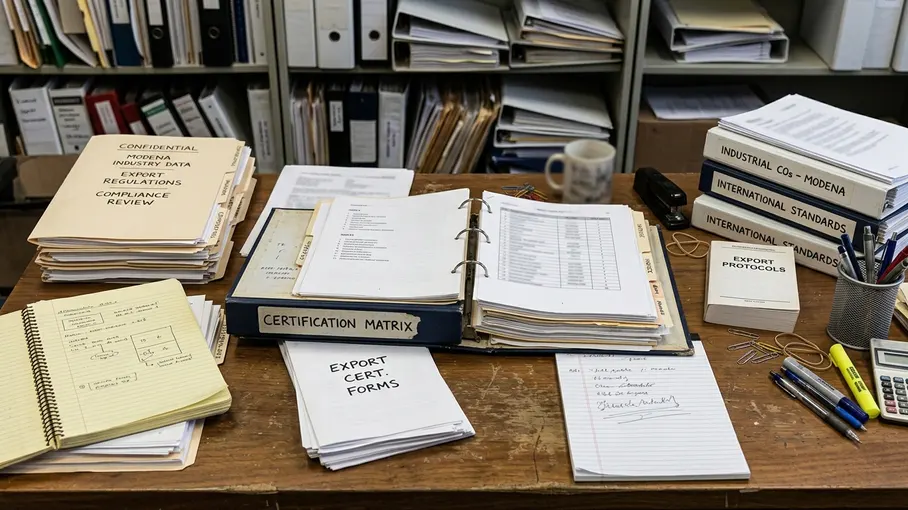
The buyer's core certification file
1. RoHS, REACH and SVHC compliance declarations
Restricted-substance evidence often arrives before performance evidence. That is the procurement reality for electrical, electronic, sensor, and component materials entering international supply chains.
RoHS, REACH, and SVHC files answer a buyer's first screening question: does this product or component family contain substances that create regulatory or customer-reporting exposure? The declaration should visibly show the declaration date, product scope, material scope, and responsible signatory.
Generic environmental statements cause trouble. Buyers commonly reject declarations that do not name the exact product, component family, or material scope being supplied. The file may look polished, but if the purchase order names one family and the declaration names another, document control sees a gap.
Warning: Do not treat a company-wide environmental statement as a substitute for a product-scope RoHS, REACH, or SVHC declaration.
2. Conflict Minerals compliance tracking
Conflict Minerals tracking is not product-performance certification. It is supply-chain due diligence.
Buyers ask for it because components may contain metals that trigger downstream reporting or customer due-diligence requests. The concern is consistency: does the supplier give the same compliance answer in customer forms, material declarations, and internal purchasing records?
A buyer once put it to me plainly: if the same product receives three different mineral answers, the issue is no longer minerals. It is control of information.
The pathway forward is disciplined mapping. Tie the material declaration, supplier questionnaire, and purchasing record to the same product identifier. If the answer changes because the bill of materials changes, record the date and reason. Silence invites rework.
3. ISO/IEC 17025 laboratory accreditation evidence
Laboratory accreditation sits in a different category from product certification. UNI CEI EN ISO/IEC 17025 and ISO/IEC 17025:2005 concern laboratory competence for test and calibration results.
That distinction helps buyers decide whether a test report carries enough weight. When calibration certificates, measurement uncertainty, interlaboratory comparisons, and traceability affect acceptance, Italy's national accreditation framework becomes part of the evidence chain. ACCREDIA is Italy's national accreditation body.
The important qualifier is narrow and practical: laboratory accreditation applies to the defined scope of the laboratory, not automatically to every measurement or test the organization performs. A certificate without scope review can mislead a procurement team.

The Modena training context sometimes cited around these topics dates to 2014. I treat it as historical professional-development context, not as a current endorsement or active course notice.
4. Calibration certificates for weighing, force and pressure instruments
Before intervention, the file often says only that the product was inspected. During engagement, the buyer asks a harder question: which instrument made the final decision? The outcome depends on calibration evidence.
Calibration certificates matter when weighing, force, pressure, or dimensional conformity decides acceptance. For a Modena-area manufacturer of load cells, pressure transducers, digital manometers, and strain-gauge-based stainless-steel measurement solutions, the certificate is not administrative decoration. It is the metrological trail behind the result.
A buyer-ready calibration certificate should identify the instrument, calibration date, method, uncertainty, and traceability chain. DT-06-DT Rev.00 is treated as a weighing-instrument calibration guide. RT-08 is treated as an ACCREDIA technical-report reference connected to calibration practice. Their relevance depends on the instrument type and accreditation scope.
Historical metrology context can also matter. Entry into the former SIT system as Centre no. 93 in 1996 belongs to that history; SIT is now within the ACCREDIA accreditation framework. Use that history carefully. It supports continuity only when the current certificate, scope, and measurement claim still align.
5. ASME Boiler and Pressure Vessel Code references
The ASME Boiler and Pressure Vessel Code is a technical code for pressure systems. It is not a generic quality badge.
In procurement, ASME references appear around pressure vessels, pressure-retaining parts, piping-related assemblies, pressure testing, and regulated or safety-critical customer specifications. The buyer wants to know whether the design, manufacturing process, inspection evidence, and customer requirement all point to the same code basis.
Suppliers should avoid broad ASME alignment claims unless the code section, design scope, manufacturing process, inspection evidence, and customer specification match. Standards-content aggregators can help retrieve documents, but they are not certification bodies.
6. ASTM standards access through ASTM Compass
ASTM belongs in this guide because buyers often cite standards by document number and revision. If a drawing names a material specification or a test method, the supplier must resolve the exact document being invoked.
ASTM is a standards provider with more than 12,000 standards. ASTM Compass functions as an online search and productivity platform for identifying, accessing, and managing technical standards used in specifications and test methods.
The commercial value is simple. A supplier that works from the wrong revision can perform the wrong test while believing the file is complete. A standards-research service provider, founded in 1984 as service providers report, is a useful generic example of support that may sit behind technical-document retrieval and standards intelligence. Access helps, but interpretation still belongs to the supplier's competent technical owner.
7. SAE Mobilus for mobility-linked files
Mobility procurement files bring their own document grammar. Drawings, test plans, and supplier quality clauses may cite SAE documents, and the supplier must prove the match.
SAE International has institutional roots going back to 1905. SAE Mobilus is relevant where exporters need to identify the exact SAE document and revision named in a customer requirement.
The buyer evidence is not database access by itself. It is the match between drawing requirement, test plan, supplier quality clause, and cited SAE document. Record the SAE reference and revision in the compliance matrix. Do not leave it in an engineer's email thread.
8. ISO 7218 and ISO 16140 for microbiology laboratory requirements
This item sits after the general laboratory-accreditation discussion on purpose. Microbiology requirements are sector-specific. They should not be mistaken for universal industrial requirements.
ISO 7218 is treated here as a microbiology laboratory requirements standard. ISO 16140 is treated as a method-validation standard. These files matter when food-laboratory work, hygiene-related testing, or microbiological method validation enters the supplier conversation.
Relevant evidence may include laboratory competence records, method validation records, treatment of measurement uncertainty, and participation in interlaboratory circuits when those activities fall within the laboratory's scope.
9. Training and competence records behind the file
Some buyers do not stop at the certificate. They ask who produced the test, calibration, or compliance record and whether that person understood the procedure.
Training records answer that question. They can support calibration practice, laboratory procedure control, substance-declaration handling, or supplier-quality documentation. The point is not to build a thick training archive. The point is to prove competence for the record being submitted.
The historical Modena context includes a course held November 26-28, 2014, with a weighing-instrument calibration module dated November 26, 2014. The registration deadline in that source context was eight days before the course start. I would present that only as past professional-development context involving a chamber-linked special agency, a partner quality association, and a local training organizer. It should not be dressed up as current availability.
Build the buyer-ready certification pack
Start with product scope. Not the company. Not the plant. The product family.
- Define the product, component family, material scope, and intended market.
- Map mandatory regulations first, including RoHS, REACH, SVHC, and any due-diligence tracking request.
- Create a standards list with document numbers and revisions, including ASTM, SAE, ASME, ISO 9001, or legacy ISO 9002 references where the buyer cites them.
- Attach declarations, test reports, calibration certificates, and laboratory accreditation scope.
- Name the internal owner responsible for keeping the file current.
Then compare every document against five categories: mandatory regulation, buyer specification, laboratory proof, calibration proof, and technical-code reference. This comparison prevents a common mistake: placing a standards-platform subscription beside a signed declaration as if both prove compliance. They do not.
Three failure modes deserve special attention: expired documents, mismatched product names, and certificates that do not cover the specific measurement or product being supplied. A shipment can meet the drawing and still be delayed because the calibration certificate does not identify the instrument used for final verification, or because the declaration names a product family different from the purchase order.
Pro Tip: Keep the certification matrix at product-family level. A single generic company folder becomes weak the moment the buyer asks for traceability.
Context changes the file. A pressure-transducer file may need calibration uncertainty and pressure-code references. A mobility-component file may turn on exact SAE document revision and material declarations. The discipline stays the same: requirement, evidence, scope, revision, owner.