For an Emilia-Romagna manufacturer, a trade corridor is not a line on a planning map. It is a commercial choice made before a truck arrives, before a container is booked, and often before the buyer signs the final order.
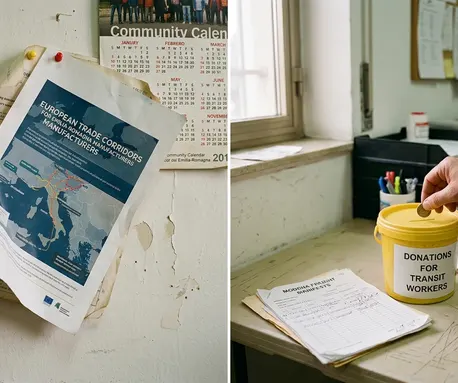
I usually start with a simple question: what promise has the exporter made to the buyer? A machine-tool shipment from the Modena area to a German plant carries a different promise than ceramic tiles leaving Fiorano Modenese (MO) for an Iberian distributor, or refrigerated agri-food equipment moving with strict handling requirements. The corridor has to fit that promise.
How corridors became industrial infrastructure
European trade corridors grew out of practical postwar needs. Industrial regions needed predictable routes across borders. Alpine passes and tunnels became more than engineering projects. Ports modernized for containers and specialized cargo. European transport coordination then gave these routes a common planning language.
That history matters because Emilia-Romagna does not export one simple product category. Its firms ship machinery, automotive components, ceramics, biomedical products, agri-food equipment, and precision manufacturing inputs. A corridor that works well for one of these cargo profiles may be awkward for another.
From geography to production-chain habit
A Modena- or Bologna-area shipment can move north toward Alpine crossings and German-speaking markets, west toward Ligurian ports and French-Iberian links, or east and northeast toward Ravenna, Trieste, the Balkans, and Adriatic maritime services. Over time, repeated use turns these choices into production-chain habits.
That is where exporters need discipline. A habitual route may still be the right route, but it should not remain unexamined. The buyer market, delivery promise, cargo sensitivity, and likely gateway should come first. The transport booking should come second.
For firms working under ISO 9001 or ISO 9002 procedures, this is not a separate logistics ritual. It belongs inside the same operational thinking that governs documentation, inspection readiness, packing control, and customer service.
The corridors most relevant to Emilia-Romagna exporters
The corridor names used in European transport planning are useful, but only up to a point. They help explain where governments and institutions coordinate infrastructure investment. They do not, by themselves, tell a Carpi (MO) exporter which carrier has capacity next Thursday.
The main institutional reference is the EU Trans-European Transport Network policy framework. The TEN-T framework sets connectivity priorities, with milestones commonly discussed around the core network, extended core network, and comprehensive network horizons of 2030, 2040, and 2050. For an individual shipment, this is a planning lens, not an operating promise.
Four corridor families to understand
For Emilia-Romagna exporters, the Mediterranean Corridor is especially relevant for westbound and east-west continental access. It helps explain links toward France, Iberia, and wider continental routes.
The Scandinavian-Mediterranean axis matters when shipments move north toward Germany and onward markets. This is often the conversation for manufacturers serving German industrial buyers, installation sites, or distributors with tight production schedules.
Adriatic-Ionian connections matter for maritime and Balkan-facing flows. They become more interesting when the buyer, vessel schedule, or cargo format points east or southeast rather than north or west.
Links into the Rhine-Alpine system support access toward Benelux, western Germany, and North Sea-linked logistics. These links can be commercially attractive, but usefulness depends on origin, cargo type, destination, customs exposure, and carrier availability.
The distinction is important. TEN-T designation signals infrastructure planning priority, not guaranteed freight capacity, schedule reliability, customs speed, or carrier availability on a specific shipment date.
Ports, rail terminals, and border crossings: where decisions become concrete
This is the point where the map has to meet the sales file.
Export teams normally move from commercial terms to physical routing. First confirm Incoterms. Then define the handover point. Then check the cargo constraints: dimensions, weight, temperature sensitivity, packing vulnerability, customs classification, and documentation burden.
Gateway choice by cargo use case
Ravenna is often considered for Adriatic-facing flows, bulk or project-style cargo, and regional port access. It can make sense when the cargo profile and buyer geography point toward the Adriatic side of the system.
La Spezia and Genoa are commonly assessed for containerized machinery and deep-sea container connections. A containerized machine tool moving to a distant buyer may need vessel frequency, terminal cut-off clarity, and container handling reliability more than the shortest road leg.
Trieste becomes relevant where rail-linked Central and Eastern European access or Adriatic maritime routing is strategic. In some cases, the rail leg after the port is the real decision point.
Ravenna, La Spezia, Genoa, and Trieste should not be ranked as universally better or worse. Their usefulness changes with cargo format, vessel schedule, rail connection, buyer location, documentation burden, and delivery promise.
The crossings that can decide reliability
Alpine road and rail crossings deserve early attention. So do winter weather exposure from December to March, scheduled maintenance windows, truck-flow controls, terminal cut-off times, and whether refrigerated or sensitive cargo needs dedicated handling capacity.
A practical pre-shipment file should include Incoterms, buyer delivery window, cargo dimensions and weight, packing sensitivity, customs classification, export documentation, terminal opening times, rail or road booking status, and fallback gateway. This sounds basic. In the field, it is often the difference between a controlled shipment and a week of phone calls.
The risk map: speed, resilience, and market exposure
Start with the uncomfortable truth: the cheapest route in a stable week may be the weakest route during disruption.
A cost-optimized corridor can depend too heavily on one port, one border crossing, one terminal, one ferry connection, one rail operator, or one customs processing point. That may be acceptable for low-urgency cargo. It becomes fragile when a buyer is waiting for components, installation equipment, seasonal goods, or parts needed for a production slot.
Risks to name before they appear
Port congestion, customs friction, industrial action, energy-price volatility, geopolitical disruption, and infrastructure maintenance all belong on the routing table. I do not treat these as abstract risks. I ask where they would interrupt the actual shipment: at the port gate, on the rail leg, at a border, at customs release, or at the buyer’s receiving dock.
Warning: A route that is cheapest in a stable week can fail commercially during Alpine maintenance, port congestion, industrial action, or customs friction if the exporter has no second gateway or carrier option prepared.
Dual-routing is especially relevant for exporters serving strategic buyers in Germany, France, Central Europe, the Balkans, and non-EU markets. Missed delivery windows can affect production schedules, installation dates, or seasonal sales cycles. The transport invoice may be small compared with the commercial damage of a missed commitment.
Public infrastructure strategies indicate policy direction over multi-year horizons. Operational resilience, however, requires shipper-specific contingency planning before annual freight negotiations, seasonal production peaks, and major contract renewals.
A practical routing framework for the next export plan
Here is the sequence I use when I want a routing discussion to stay concrete. It works best before the quote is finalized, not after the warehouse has packed the goods.
Decision checklist
- Destination market: define the buyer country, receiving site, and onward distribution point if there is one.
- Cargo type: separate containerized machinery, heavy ceramics, bulk or project cargo, refrigerated equipment, and sensitive components.
- Delivery promise: identify whether the commitment is a fixed arrival date, an installation window, a production input deadline, or a flexible delivery period.
- Customs exposure: check classification, export documentation, non-EU requirements, and any buyer-side clearance constraints.
- Port access: compare Ravenna, La Spezia, Genoa, Trieste, or other gateways against the actual cargo and destination, not reputation alone.
- Rail option: test whether an intermodal leg improves reliability, cost control, or inland access.
- Backup route: name the second gateway, crossing, carrier, or terminal before the preferred route is disrupted.
- Buyer service expectations: confirm what the customer needs to know if timing changes: revised arrival date, document status, installation impact, or alternative delivery plan.
Practical point: Emilia-Romagna firms should treat corridors as commercial infrastructure, not just transport geography.
Timing point: Review routes before peak production cycles, major trade fairs, and contract renewals rather than after disruption occurs.
Which corridor would still protect the buyer relationship if the preferred route failed next week?