In this Article
- The strongest export use of ISO 9001 is commercial, not administrative
- What international buyers actually infer from an ISO 9001 certificate
- Translate the standard into the questions procurement teams ask
- Build a buyer-ready evidence pack before the tender arrives
- How to answer supplier questionnaires without weakening credibility
- Use ISO 9001 to reduce friction after the first order
- A practical final test: would the buyer understand your system in ten minutes?
The strongest export use of ISO 9001 is commercial, not administrative
ISO 9001 has its greatest export value when a company uses it as a shared risk language with buyers, procurement teams, and supplier quality engineers.
That is the starting point I use with exporters in Modena. Not the certificate frame on the wall. Not the audit file. The commercial value appears when the system helps a buyer understand how orders become controlled production, inspected shipments, traceable records, and corrective action when something goes wrong.
The common mistake is simple: the exporter presents the certificate as the answer. The buyer is often asking a deeper question.
Warning: A certificate can fail commercially when the buyer asks how drawing revisions are controlled and the exporter can only forward the ISO 9001 PDF without showing order review, revision control, or release records.
This matters in supplier qualification, tender submission, onboarding, and periodic supplier review. A machinery subcontractor in Modena, a ceramics exporter in Fiorano Modenese (MO), a biomedical supplier, a packaging firm near Carpi (MO), and an automotive components producer may all hold ISO 9001. The buyer will still interrogate different risks: calibration control, fragile packaging approval, regulatory interfaces, labelling accuracy, subcontracted treatments, or release records.
So the useful question is not, “Do we have ISO 9001?” It is, “Can a buyer see how our system protects their order?”
What international buyers actually infer from an ISO 9001 certificate
First, they verify the certificate
ISO 9001 is a quality management system standard. It is not a product approval, a regulatory authorization, a sector licence, or a guarantee of defect-free deliveries. The official description of ISO 9001 quality management systems makes that distinction clear: the standard concerns how an organization manages quality, not whether every individual product automatically conforms to every market rule.
Buyers usually start with the formal checks: certificate holder name, site address, certified scope, issuing certification body, accreditation reference where relevant, issue date, expiry date, and exclusions or limitations in the scope wording.
Then, they test the match
The certificate must match the commercial reality. If the buyer purchases machined components from one site, but the certificate covers a different legal entity or a sales office only, the document loses force. If the scope says distribution and the tender concerns manufacturing, questions follow.
This is where exporters should slow down. Buyers will check whether the certified scope, legal entity, and production site match the goods or services being purchased. That check is not bureaucracy. It is procurement risk control.
Finally, they infer process discipline
From a valid and relevant ISO 9001 certificate, buyers expect controlled processes for customer requirements, documented responsibilities, change management, supplier control, production monitoring, nonconformity handling, and improvement.
In practice, they are asking: can this supplier repeat what it promised?
Translate the standard into the questions procurement teams ask
Clause language rarely wins trust in an export conversation. Buyer questions do.
Customer requirements
A procurement team wants to know who reviews the order before acceptance. Can the exporter prove that specifications, drawings, tolerances, packaging rules, labelling requirements, and Incoterms-related responsibilities were checked against the quotation and purchase order?
Good evidence includes signed order reviews, controlled drawings, tolerance confirmations, packaging approvals, labelling instructions, accepted deviations, and clear records of who approved what.
Operational control
The next layer is production discipline. Can the exporter show how production, inspection, calibration, outsourced processes, and release checks are managed?
- Inspection plans show what gets checked and when.
- Calibration status records show whether measuring equipment can be trusted.
- Outsourced-process controls show how subcontracted work is monitored.
- Release checks show which function authorized shipment.
For a Modena mechanical components supplier, I would rather see one clear inspection release record for a real shipment than ten pages of polished policy language.
Nonconformity management
When a defect appears, the buyer looks for sequence. Immediate containment is not root-cause analysis. Root-cause analysis is not corrective action. Corrective action is not complete until someone checks whether the problem returned.
Separate the steps: containment, cause analysis, corrective action, effectiveness check, and customer communication. That separation signals control.
Build a buyer-ready evidence pack before the tender arrives
The best evidence pack is compact. Sales can use it. Export can explain it. Quality can defend it.
I build it by asking one plain question: what does a buyer normally request before trust is established? The answer is not a complete audit archive. It is a qualification set that proves the system exists in daily work.
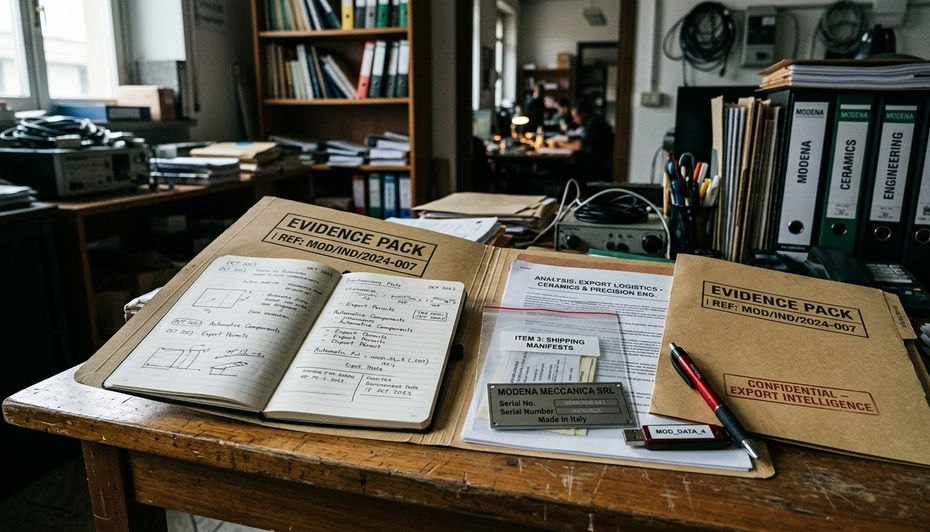
Core documents
- Current ISO 9001 certificate with legal entity, site, scope, certification body, and expiry date visible.
- Certified scope statement written in buyer-friendly English.
- Organization chart or responsibility matrix.
- Process map.
- Quality policy.
- Supplier evaluation procedure.
- Complaint and corrective action workflow.
- Calibration or inspection control summary.
- Recent management review themes, where shareable.
Export-specific additions
- Order review checklist.
- Multilingual specification control approach.
- Packaging approval process.
- Export documentation controls.
- Escalation route for delivery or customs-related quality issues.
Practical point: Maintain one English quality profile that uses the same legal entity name, site address, certified scope wording, and activity description as the certificate.
Before release outside the company, redact confidential customer names, proprietary process parameters, personal data, and non-relevant audit findings. Buyers need confidence, not unrestricted access.
How to answer supplier questionnaires without weakening credibility
Supplier questionnaires expose inconsistency fast. They compare how the company describes itself against the certificate, the website, the tender file, and the answers from sales.
Old templates sometimes still mention ISO 9002 or use outdated category language. Do not improvise. Answer with the current ISO 9001 position, the exact certified scope, and a short explanation of how the requirement is controlled.
Use evidence-shaped answers
A strong answer normally does four things: it names the controlled process, identifies the responsible function, states the review trigger or frequency where relevant, and points to the record that proves the claim.
Weak answer: “We follow ISO procedures.”
Stronger answer: “Sales and Quality complete contract review before order acceptance; controlled specifications, drawing revision, packaging requirements, and delivery terms are checked against the quotation and purchase order.”
Weak answer: “Complaints are managed according to ISO 9001.”
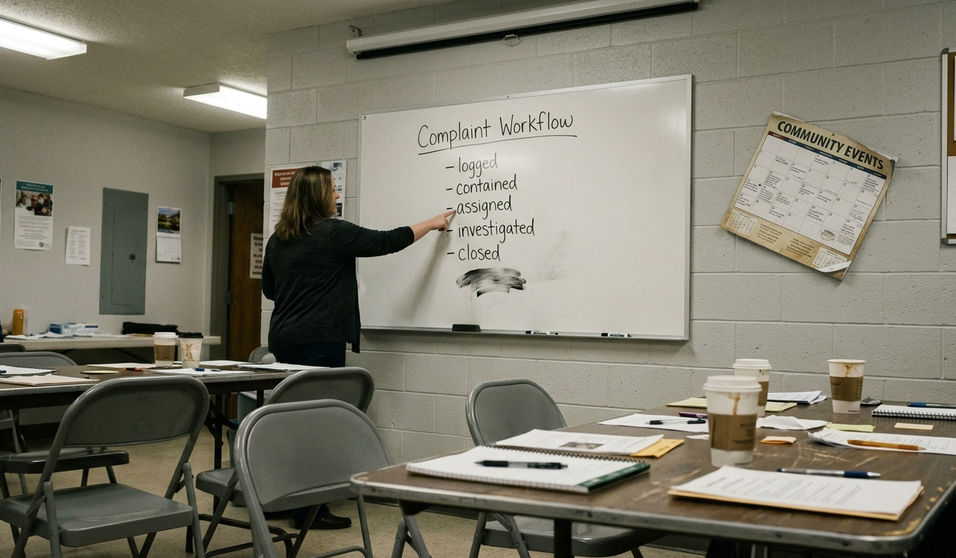
Stronger answer: “Customer complaints are logged, contained, assigned to a responsible function, investigated for cause, closed with corrective action, and reviewed for recurrence.”
Keep the buyer’s risk in view
If the buyer asks about traceability, do not answer with a general statement about quality culture. Show how batches, lots, serial numbers, inspection records, or shipment references connect. If the buyer asks about supplier monitoring, identify the owner, the evaluation method, and the action route when a subcontractor underperforms.
Short answers can be more credible than long ones. Precision carries weight.
Use ISO 9001 to reduce friction after the first order
The real test often begins after award. Buyers judge the system when specifications change, shipments run late, defects appear, or documents arrive incomplete.
Make routines visible at export friction points
ISO 9001 practices become visible in contract amendments, drawing revisions, first-article or sample approval, packaging changes, logistics incidents, complaint response, corrective action follow-up, and shipment documentation checks.
For a ceramics exporter in Fiorano Modenese (MO), packaging approval may matter as much as kiln control in the buyer’s mind. For a biomedical supplier, regulatory interfaces and customer-specific approvals may sit beside the quality system. For a machinery subcontractor, outsourced treatments and calibration records can decide whether the buyer trusts the release.
ISO 9001 provides a management framework, but sectors such as medical devices, aerospace, food-contact materials, and safety-critical applications may still require additional standards, regulatory approvals, customer approvals, or product-specific conformity evidence.
Turn records into commercial tools
- Use a shared issue log for open quality and delivery topics.
- Record deviation approvals before shipping non-standard goods.
- Maintain a revised specification register for changed drawings.
- Keep inspection release records close to shipment documents.
- Close complaints with evidence, not only apology emails.
Key point: The buyer does not experience the quality system as a manual. The buyer experiences it through response time, document clarity, controlled changes, and disciplined follow-up.
A practical final test: would the buyer understand your system in ten minutes?
Before a major tender or buyer audit, run a short internal rehearsal. Sales, quality, production, and logistics should sit together and test whether the export manager can explain the system without searching through folders.
The ten-minute readiness check
- What does the certificate cover?
- Which legal entity and site does it apply to?
- Who owns order review?
- How are specifications and drawing revisions controlled?
- Who approves changes before shipment?
- Where is the inspection release record?
- How are complaints logged?
- Who owns corrective action?
- Who is the escalation contact for delivery or customs-related quality issues?
If the answers sound different depending on who speaks, fix the evidence pack before the buyer asks. Supplier questionnaires expose inconsistency when the English profile, certificate scope, legal entity name, and site address do not match exactly.
On a rainy morning in a Modena components workshop, an export manager places four documents on the meeting table: the certificate, the order review checklist, the inspection release record, and the corrective action log. Production has marked the latest drawing revision. Logistics has added the shipment document check. The video call opens with a German buyer, and the first questions are practical, not generic, because the system is already visible.